generated gpt
Europe's Dominance in Global Factoring: €2 Trillion Turnover and New Technological Challenges
Europe holds 56% of the global factoring market with a €2.66 trillion turnover. Yet, traditional bank factors are slowing down, ignoring SMEs and small-ticket deals. Discover how digital RWA platforms like Edenex are tokenizing invoices to bypass bureaucracy, cut costs, and unlock liquidity for the mid-market.
Factoring is a popular instrument for many companies to manage working capital. By selling their accounts receivable (unpaid customer invoices) to a factor, a company receives financing immediately after shipment, rather than waiting 30–120 days. An important advantage of factoring is that it does not increase the debt burden on the balance sheet and does not require collateral, unlike a classic loan.
In 2026, the global factoring market is valued in trillions of dollars, but its geographic distribution is extremely uneven. Absolute leadership is historically held by Europe, which is even showing growth.
According to the EU Federation for the Factoring and Commercial Finance Industry (EUF):
Factoring turnover in the Eurozone exceeded €2.44 trillion in 2023;
In 2025, it reached €2.66 trillion.
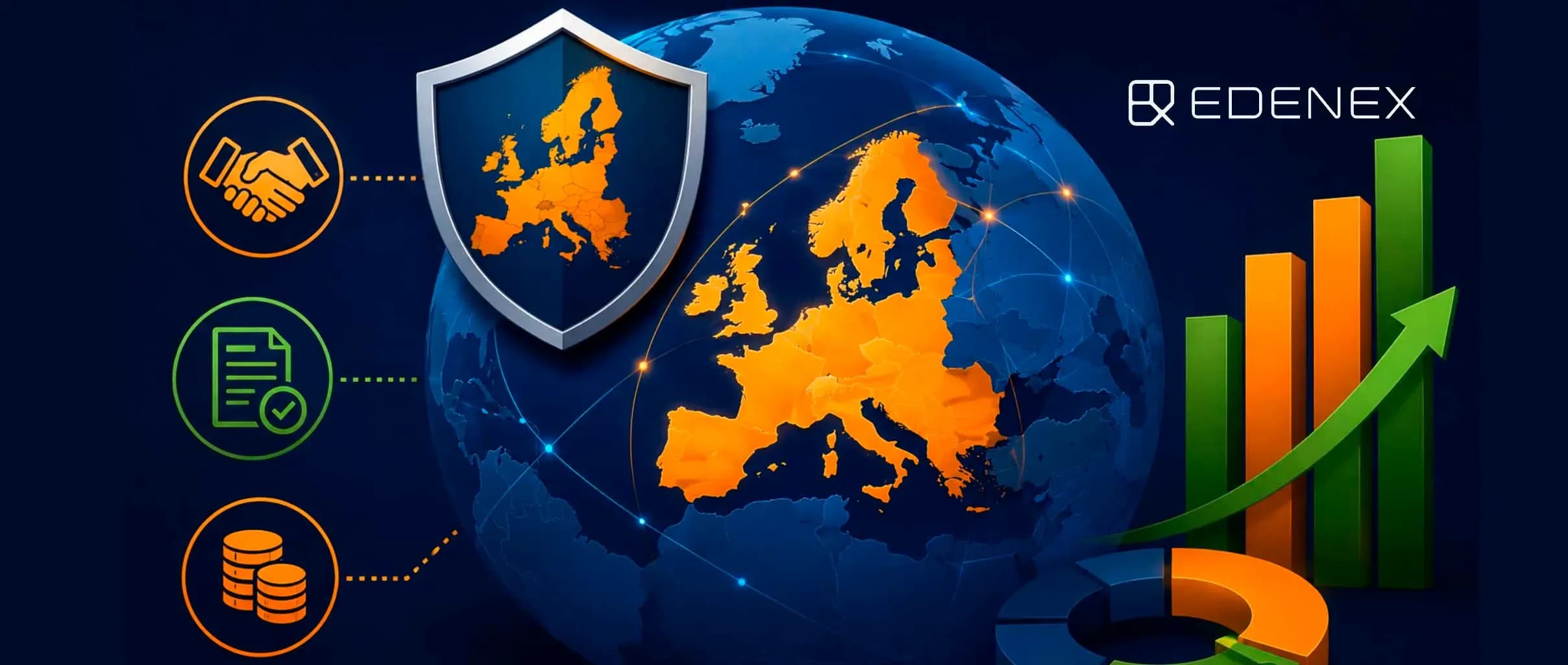
In 2026, the European market continues to dominate the factoring market, accounting for 56% of the global transaction volume.
Today we live in an era of high interest rates, where banks are tightening lending conditions and reducing financing limits. In this situation, the demand for factoring in the EU is growing. Experts say that it has become the main survival tool for European businesses, ensuring the liquidity of supply chains.
At the same time, its share in the region's economy already exceeds 11.5% of GDP. This indicates that the instrument is deeply embedded in the real economy and is actively used by companies.
Why Europe? Three Pillars of Dominance in the Factoring Market
There are 3 fundamental reasons why the EU leads the factoring market in 2026.
1. Culture of payment deferrals. In Europe, companies are accustomed to working with deferred payments through open accounts. 30-120 days is the standard term from receipt to payment for goods, with about 40% of European companies waiting for payment for more than 60 days.
As a result, the European model generates huge volumes of accounts receivable — money is frozen in accounts, and companies need something to finance their operations.
In other regions of the world, other instruments dominate: in the US, businesses more often use corporate credit cards, and in Asia — letters of credit.
2. Legal framework and standardization. Europe has long had common rules of the game in the factoring market. For example, the EU Late Payment Directive, which was adopted in 2011, and transparent mechanisms for the assignment of claims (cession). They make the purchase of invoices safe for factors in all Eurozone countries.
Legislation is being further improved. From 2025, the ViDA (VAT in the Digital Age) package comes into force. It will require companies from 2030 to use electronic invoices for cross-border transactions. This will increase their transparency and accelerate trade finance.
Also, according to Euronews.com, the European Banking Authority (EBA) adopted new rules in 2026: delays of up to 90 days are now considered technical delays, not default. This simplifies the work of factors.
3. Developed FCI network. European banks historically dominate the international association FCI (Factors Chain International), which unites more than 400 members from 90 countries. Since banking divisions control more than 90% of all European factoring, European companies are able to conduct cross-border transactions without barriers with the participation of two factors (import and export).
Structure of the European Market: Leaders and Product Types
The lion's share of the total European factoring turnover comes from just five countries, which together provide 71% of the total volume:
France;
Germany;
United Kingdom (not part of the EU);
Italy;
Spain.
The leadership of these 5 countries in factoring is by no means accidental. According to IMF data for 2026, they are among the top five leaders of the European Union in terms of GDP. Germany, the United Kingdom and France together generate more than 40% of all economic activity in Europe.
Thus, dominance in factoring directly correlates with the scale and maturity of national economies. Businesses in the most developed countries are the most active in using advanced financial instruments.
One of them is non-recourse factoring. It accounts for about half of the European market. In 2026, companies are massively choosing this model, which allows them to fully transfer the credit risk of buyer default to the factor. This "cleans" the company's balance sheet before an audit.
The popularity of non-recourse factoring is reinforced by the tightening of bank credit standards and the growing number of bankruptcies in the Eurozone. Their number has been growing for the fourth year in a row and has reached a 20-year high, according to the Norwegian agency Creditinform.
Supply Chain Finance (reverse factoring) is actively developing. Large European buyers (retail, automotive) themselves initiate financing programs for their suppliers to maintain the stability of supply chains.
However, there is an extremely important limitation. Classical European factoring is an instrument for large and stable businesses. The average transaction size is €1 million, and the client's turnover is about €8 million. That is, banks and factors cut off small players. Companies with small invoices or unstable revenues find it difficult to obtain financing.
European factoring companies serve more than 300,000 active clients. This is a significant but limited base, leaving millions of small enterprises "overboard." They create a large demand for alternative solutions that could work with more accessible amounts.
| Criterion | Traditional Bank Factoring (EU) | RWA Platforms (Digital) |
|---|---|---|
| Geographic Barriers | High for non-EU countries; complex compliance | Low; operate globally |
| Underwriting Speed | Days-weeks (counterparty verification) | Hours-days (API, AI scoring) |
| Average Operating Commission | 1-3% of the invoice amount | 0.5-2.5% of the invoice amount |
| Crediting Speed (T+) | T+1-3 business days | T+0 (same day) |
| Access for Mid-Market | Banks avoid deals < €100K | Available for small and medium amounts |
| Collateral Requirements | Indirect (via counterparty) | Often unsecured (except for the invoice) |
Growth Boundaries: Where the European TradFi Machine Stalls
At least 3 factors significantly slow down the further spread of the factoring instrument in the European Union.
1. Suffocating compliance. Banks today spend weeks instead of days on checking cross-border transactions. The reason for this is strict legal regulations that are becoming stricter. Due to new requirements for customer verification (KYC) and anti-money laundering (AML), banks are required to update client data more often, check beneficiaries and demand more documents to confirm identity.
The full entry into force in July 2026 of the MiCA regulation, a comprehensive EU law on cryptocurrencies, further tightens the screws. It requires all crypto companies in Europe to obtain a license, disclose information to investors and comply with strict reserve rules for stablecoins.
Additional barriers are created by the ViDA package (electronic invoices) and the CESOP system, which requires detailed reporting on cross-border payments. Banks have tightened verification of counterparties, especially if they are located outside the EU.
2. Ignoring small businesses. Factor banks are reluctant to work with transactions of less than €100,000. The complexity of the procedures and high operating costs make such transactions unprofitable for them.
According to the Cambridge Centre for Alternative Finance, 43% of small and medium-sized enterprises refuse factoring because of the complexity of the process.
How Edenex Puts the €2 Trillion Market on Global Digital Rails
So, the European factoring market has a turnover of €2 trillion. This is a huge amount of money circulating in supply chains. But access to it is blocked by bureaucracy: banks require piles of documents, check deals for weeks, and do not consider deals up to €100,000 at all.
The Edenex platform changes the rules of the game by bringing accounts receivable into the digital circuit. Invoice tokenization technology turns the right of claim under a contract into a liquid digital asset (RWA), which can be offered to pools of institutional investors. This is possible without collateral, without credit committees and regional restrictions.
How it works in practice:
a company uploads an invoice for an export contract;
the platform scores the transaction and verifies the debtor;
investors see the asset and offer financing;
money is credited to the account within 48 hours;
payment from the buyer is automatically directed to the investors.
Key advantages of the model:
time to receive money is reduced from weeks to two days;
minimum transaction amount is not limited — available for medium-sized businesses;
investors gain access to high-quality European assets with fixed returns;
all operations go through full KYC/AML compliance, meeting European regulatory requirements.
European factoring is huge, but its archaic infrastructure is hitting a regulatory dead end. The future lies in transferring claims into the digital circuit.
FAQ: Frequently Asked Questions
Why is non-recourse factoring so popular in Europe? Because it transfers the risk of buyer non-payment to the factor. This is especially relevant amid rising bankruptcies and tightening bank requirements. The seller receives money and clears the balance sheet — if the buyer does not pay, the factor takes the losses upon itself. For companies with foreign trade operations, whose buyers may be located in countries with unstable regulation, this becomes critically important.
How does invoice tokenization reduce costs compared to international factoring? In the traditional scheme, two factors are involved — import and export. Each takes its own commission, which doubles costs and delays the process. Tokenization through Edenex removes intermediaries: invoices are sold directly to investors. The time to receive money is reduced from three days to one (T+0), and commissions are reduced by eliminating double margin.
Does the European Late Payment Directive affect the operation of digital platforms? Yes, it does. An update to the directive is currently being discussed to make the rules clearer and strengthen control over their compliance. Digital platforms will have to comply with new requirements for electronic invoices (standard EN16931) and reporting on cross-border payments. However, the regulatory environment itself is becoming more transparent, which ultimately simplifies the work of RWA platforms.
Can tokenization completely replace bank factoring in Europe? In the coming years — unlikely. Banks will remain key players in the segment of large transactions and complex corporate structures. However, tokenization will occupy the niche of medium-sized businesses and transactions up to €1 million, which banks find unprofitable to service. In the perspective of 3-5 years, the two models will coexist: banks for complex structures, platforms for fast and transparent transactions.