
Edenex team
Explosive Growth of the Tokenized RWA Market: Key Metrics, Statistics, and Macroeconomic Trends
Analysis of the on-chain RWA (Real World Assets) market in 2026. Statistics on tokenized government bonds, real estate, private credit, and commodities.

Explosive Growth of the Tokenized RWA Market: Key Metrics, Statistics, and Macroeconomic Trends
In 2026, RWA tokenization has moved beyond the simple "digitization of an asset" — the focus is now on settlement rails: custody of tokens, finality of settlement, atomic swap (delivery versus payment), collateral mobility on blockchain, and integration with traditional banking back-office systems.
Creating a digital representation of real estate, bonds, or gold is technically no longer challenging. The primary issue currently is not token issuance but its integration into interbank circulation, which requires uniform settlement rules, clear legal status, compliance procedures, and a stable market with liquidity.
Traditional settlement systems with T+1 or T+2 cycles create a time lag between the transaction and its final settlement: they require a correspondent network, prefunding, and default risk at each link — liquidity is locked up, and risks are distributed along the chain.
Blockchain offers T+0, programmable settlement, and immediate title transfer without extended correspondent relationships. Consequently, in 2026, RWA tokenization is no longer a digital asset market but an infrastructure layer where the token functions as the settlement-legal interface between on-chain capital and TradFi.
Global RWA Market Volume in 2025–2026: Figures and Forecasts
Before presenting figures, it should be noted that current market volume estimates for tokenized real-world assets and long-term forecasts diverge significantly due to methodological discrepancies in calculations.
Analytical platforms such as Dune Analytics and RWA.xyz capture only "net" distributed capital on public blockchains — assets that are actively traded, transferred, and utilized in DeFi protocols. Consulting giants like BCG take a broader view: they assess global tokenization across the entire financial system, including closed institutional registries and illiquid assets that will be digitized on any type of DLT.
Another methodological divide is the treatment of stablecoins. If included in the TVL of the RWA sector, total on-chain capital exceeds $300 billion (data from RWA.xyz and DefiLlama). However, most institutional reports deliberately exclude stablecoins and CBDCs from calculations to avoid double-counting and to assess specifically the market for tokenized securities and investment assets.
Current Statistics
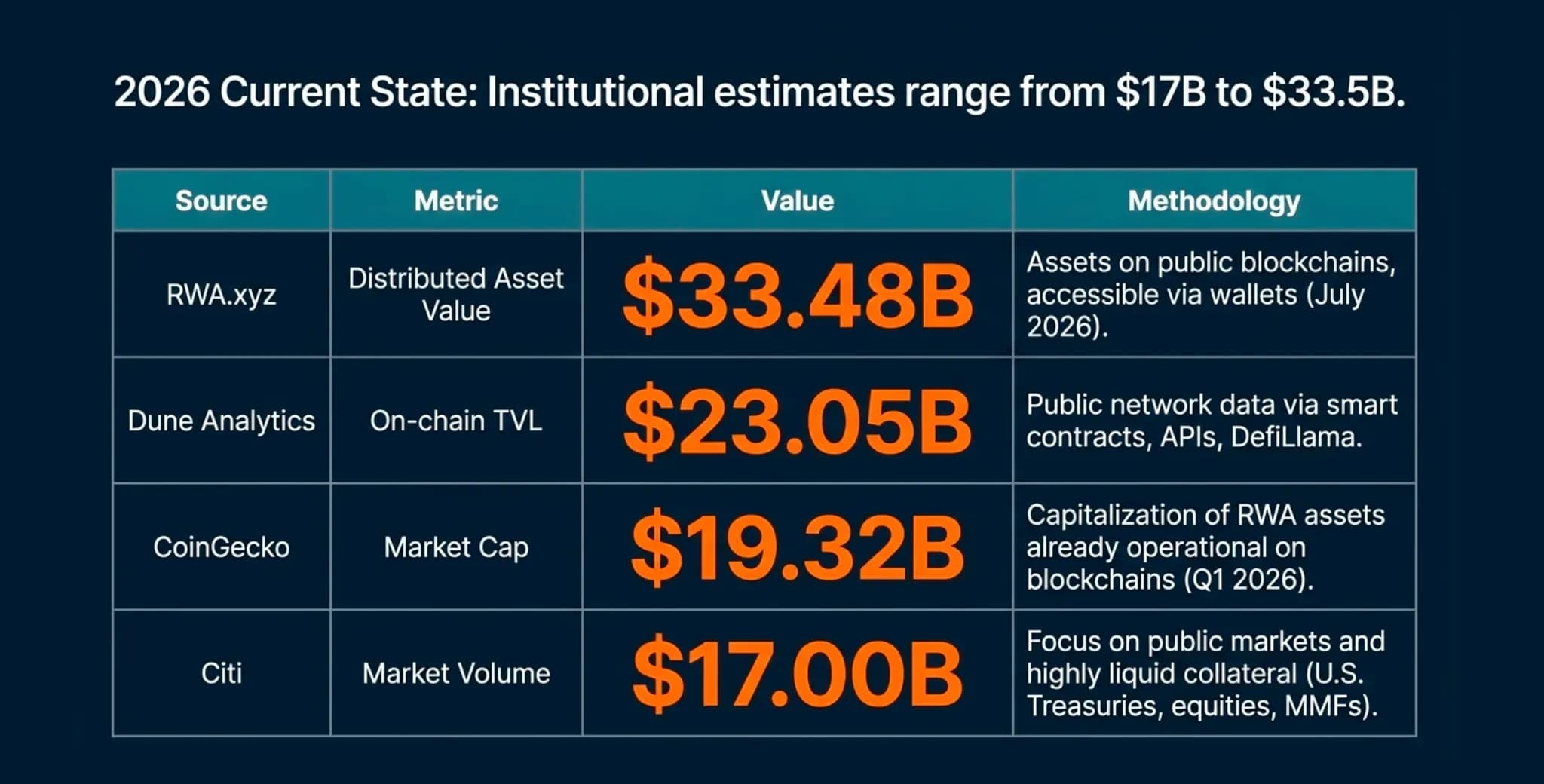
Estimates of the current tokenized RWA asset market volume range from $17 billion (Citi) to $33.5 billion (RWA.xyz), depending on the accounting methodology: public blockchain aggregators report higher figures due to direct on-chain scanning, while bank reports apply more conservative filters.
According to RWA.xyz, which aggregates data from 30+ blockchain networks, as of July 2026, the net on-chain RWA (Distributed Asset Value) is approximately $33.48 billion. These are assets issued directly on public blockchains, accessible for storage and transfer via investor wallets, excluding stablecoins and corporate closed registries.
CoinGecko, in its RWA Report 2026, cites similar figures: the total market capitalization of tokenized RWAs grew by 256.7% over 15 months — from $5.42 billion at the beginning of 2025 to $19.32 billion by March 31, 2026.
According to Dune Analytics on-chain dashboards, the net public on-chain RWA TVL is approximately $23.05 billion.
According to Citi estimates, as stated in its June report Tokenization 2030: Wall Street On-Chain, the global tokenized asset market in 2026 is approximately $17 billion.
Forecast Dynamics
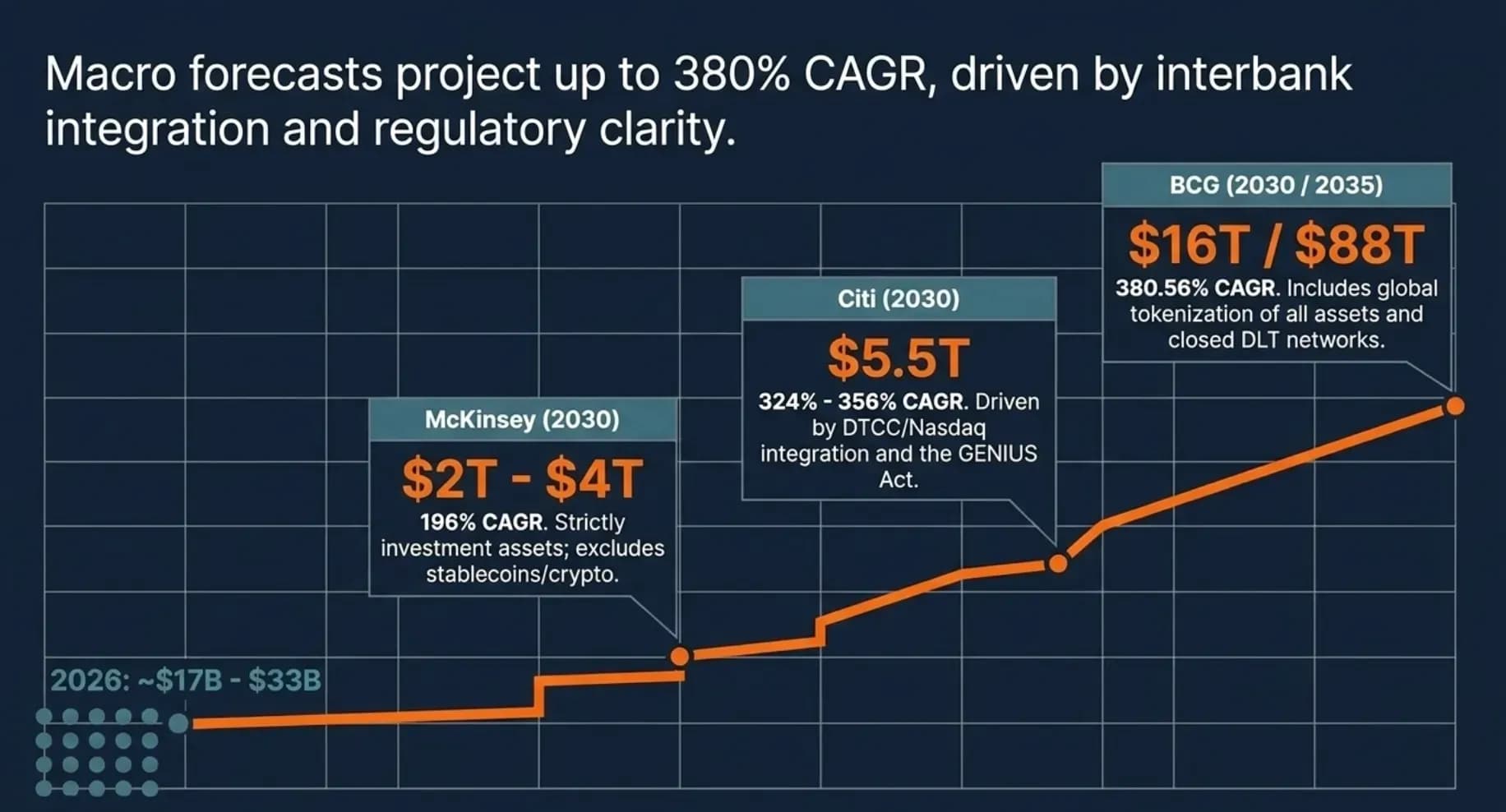
Forecasts from major investment banks and consulting agencies show considerable divergence: from $2 to $16 trillion by 2030. The projected compound annual growth rate (CAGR) of the tokenized asset market, based on their various estimates, reaches 190–350%, indicating significant expert optimism. The spread is determined by which assets and which types of registries are included in the calculations.
Citi forecasts a target volume of tokenized securities of $5.5 trillion by 2030 (range: $2.7–8.2 trillion). Thus, Citi's CAGR from the current ~$17 billion is extremely optimistic: approximately 324% – 356%. Key drivers: integration with DTCC and Nasdaq, stablecoin market growth to $1.9 trillion, and regulatory clarity in the U.S. (GENIUS Act).
McKinsey provides a more conservative estimate, deliberately excluding cryptocurrencies, stablecoins, and CBDCs: $2 trillion (baseline) and $4 trillion (optimistic) by 2030.
BCG maintains the most aggressive forecast: $16 trillion by 2030. By 2035, according to BCG estimates, tokenized RWAs will reach $88 trillion, constituting 16% of all global investment assets.
Structure of the On-Chain RWA Market: Key Verticals
The RWA market has matured, and its structure clearly shows several main directions.
Tokenized Sovereign Debt (U.S. Treasuries). The fastest-growing segment of the RWA market, reaching ~$14.86 billion by mid-2026 (compared to less than $4 billion at the beginning of 2025).
Private Credit (On-chain Private Credit).
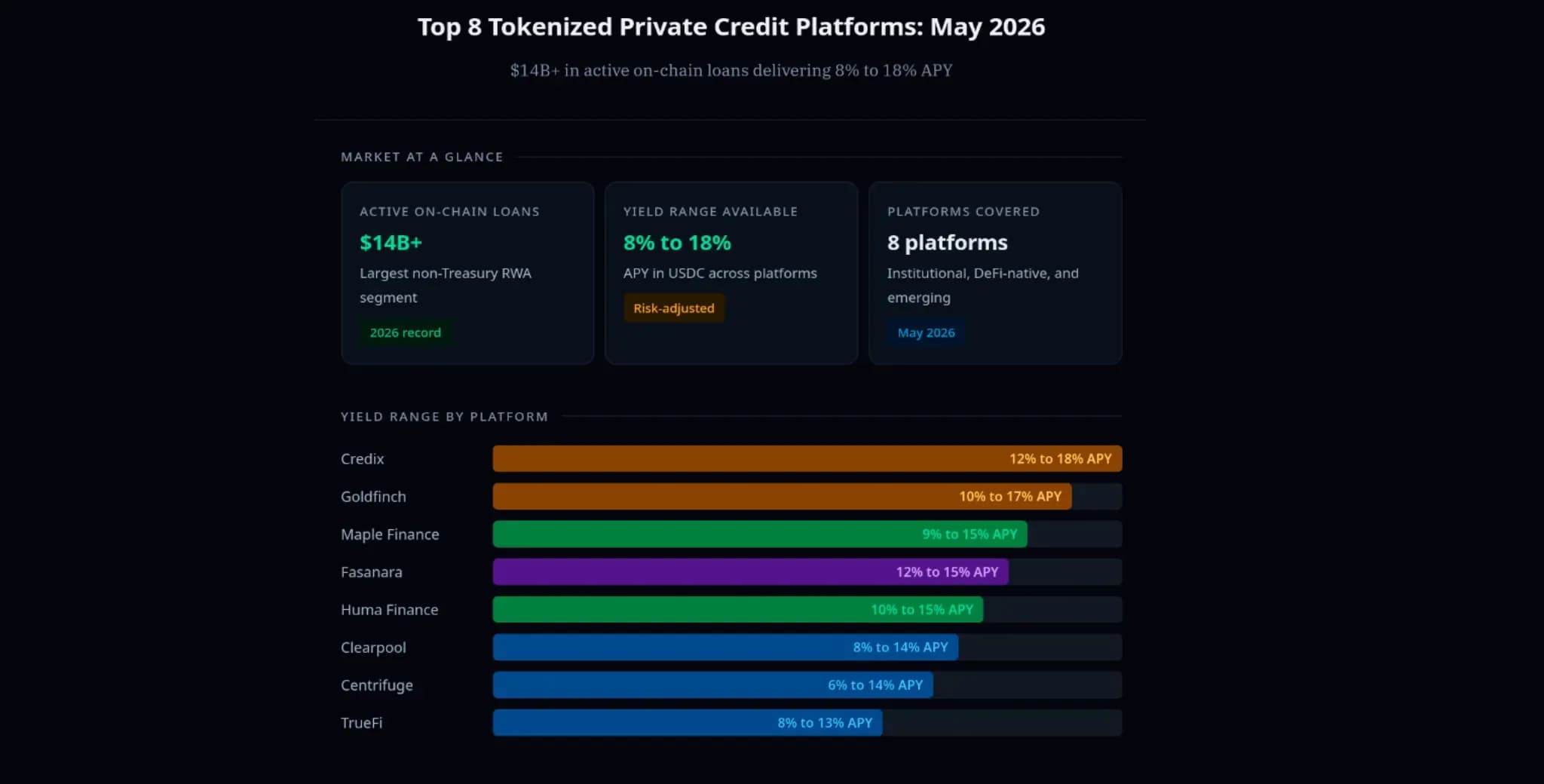
According to StablecoinInsider.org, tokenized private sector lending grew to $14 billion in open positions, surpassing all other non-Treasury directions and establishing itself as the largest segment in this category. Key players include Maple Finance (institutional pools and retail platform Syrup); Centrifuge (structured credit and trade finance, with deep integration into the Sky protocol, formerly MakerDAO); Goldfinch (emerging markets); Clearpool (permissioned borrower pools); and Figure (unquestioned leader in consumer lending (HELOCs and mortgages) on the Provenance blockchain).
Commodities.
According to RWA.xyz, the total market volume of tokenized commodities reached approximately $4.6 billion in July 2026, and this sector is almost entirely (over 95%) represented by precious metals.
Real Estate.
As of mid-2026, the share of tokenized real estate in the RWA market is estimated by analysts as extremely small in the current on-chain volume, but possessing significant long-term potential in forecasts (TAM). For instance, fractional real estate ownership via tokenization of square meters has considerable potential. Unlike standardized securities, real estate is strictly tied to local legislation. RWA.xyz estimates the share of tokenized real estate in the market at just over $200 million. The expansion of real estate in the RWA market is hindered by a heavy legal environment.
Technology Stack and Regulatory Landscape in 2026
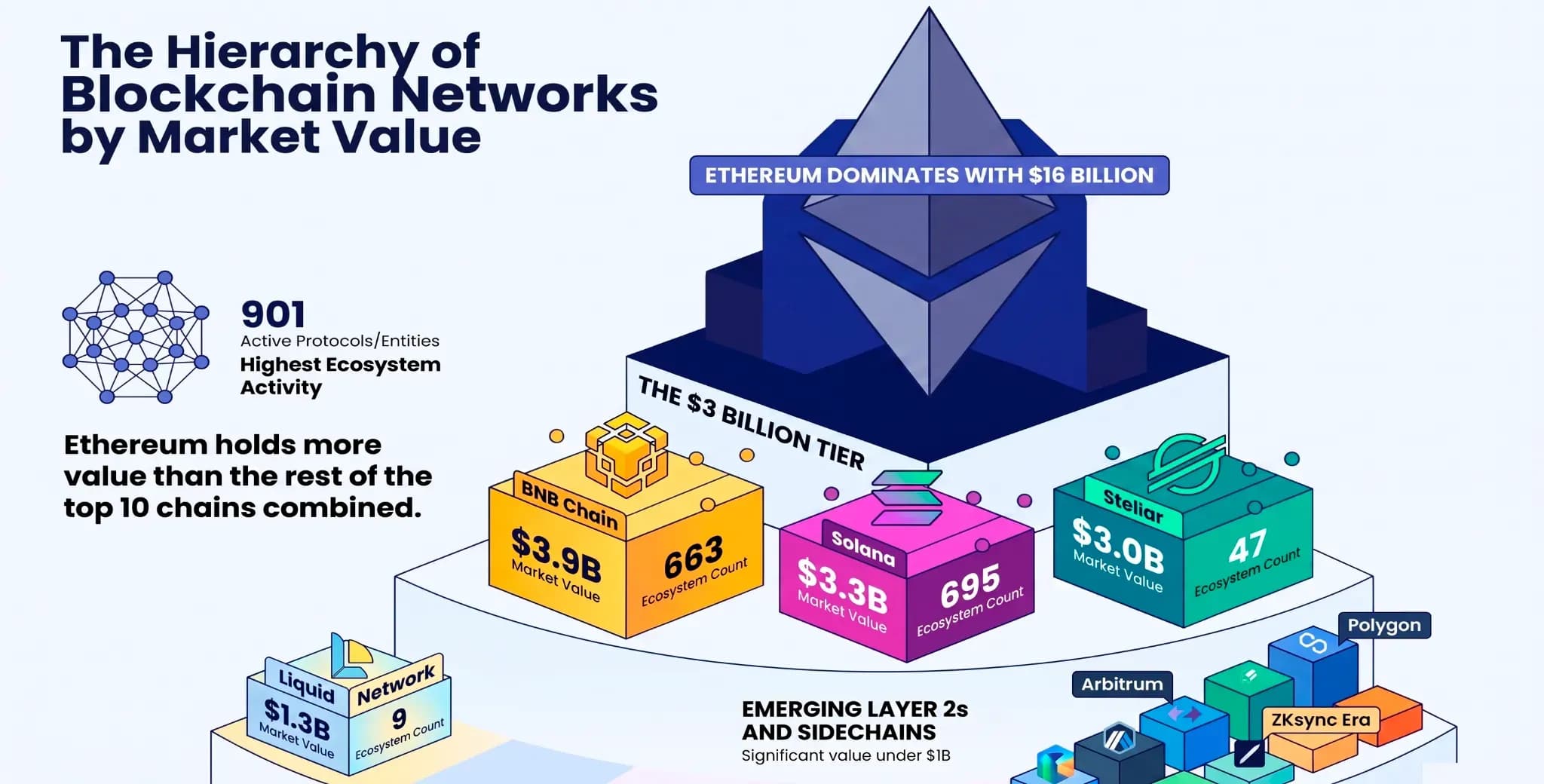
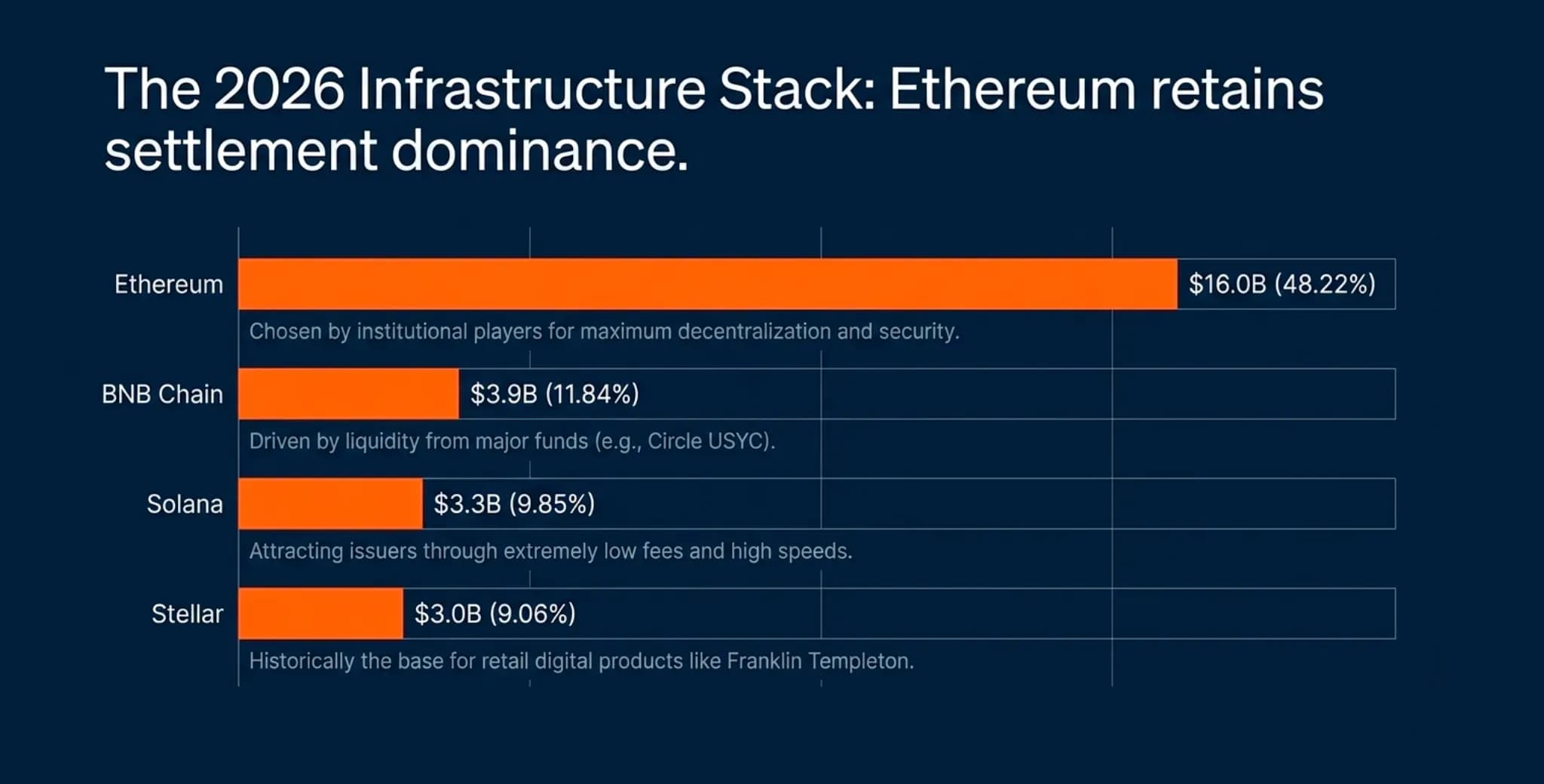
As noted, the public on-chain RWA market (Distributed Asset Value) is estimated at ~$33.11 billion according to RWA.xyz as of July 2026. Based on this, the capital concentration across major blockchains can be assessed.
Ethereum — the absolute leader with $16.0 billion (48.22% market share). Institutional players choose the network as the base settlement layer due to maximum decentralization and security.
BNB Chain — second by volume with $3.9 billion (11.84%), largely due to liquidity from major funds (e.g., distribution of tokenized Treasury bills by Circle USYC).
Solana reached a volume of $3.3 billion (9.85% share), attracting issuers with low fees and high transaction speed.
Stellar holds $3.0 billion (9.06% share), historically a key base for Franklin Templeton's retail digital products.
Frequently Asked Questions (FAQ)
Question 1. How does a tokenized RWA asset differ from traditional securitization or ABS?
ABS is a traditional legal construct, whereas RWA tokenization transfers the underlying asset and the rights to it into blockchain form. Smart contracts automate waterfall payments, reduce intermediary costs, and enable 24/7 liquidity.
Question 2. What are the main risks of investing in tokenized private credit?
Three key risks: credit risk of the ultimate borrower, technical risk of smart contract vulnerability, and regulatory risk of changes to the token's legal status. Additionally, liquidity, collateral quality, and potential redemption delays are important factors.
Question 3. Why are stablecoins often excluded from net RWA statistics?
Because stablecoins are primarily a payment instrument and an infrastructural fiat proxy, not RWA in the narrow sense. Net RWA statistics typically include assets that themselves generate yield or represent an investment instrument: bonds, equities, commodities, and private credit.
Question 4. What is more important when choosing an RWA platform: yield or structure quality?
Structure quality is more important: legal isolation of the asset, custodian reliability, reserve transparency, redemption terms, and compliance are often more critical than the stated APY. High yield without a bankruptcy-remote SPV, PoR, and a clear redemption mechanism typically indicates elevated hidden risk.