GPT genetared picture
Risks of Real-World Asset (RWA) tokenization
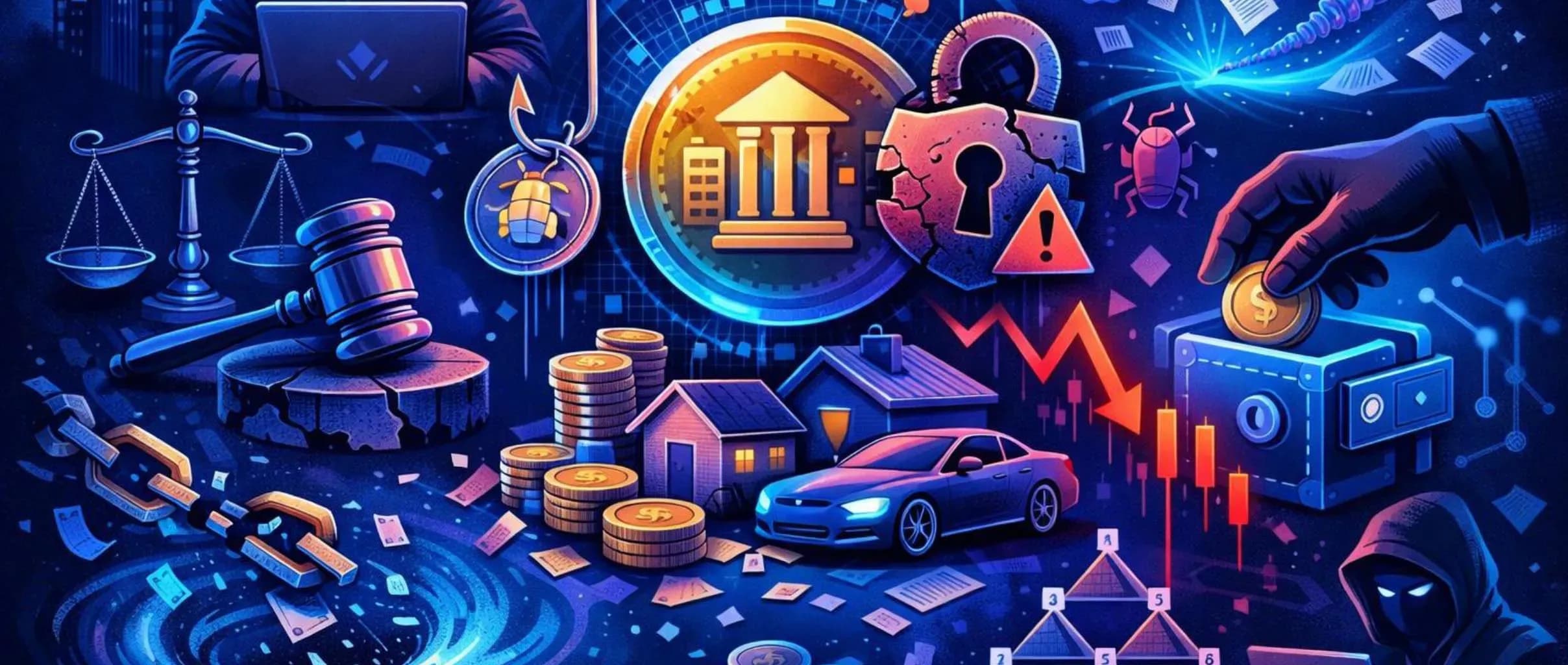
RWA looks like a revolution, smells like legacy risks. Liquidity mirage, regulatory chaos, smart contract landmines, and the golden registry dilemma. Don't sleep on the risks.

The rise of RWA is hiding real problems: liquidity illusion, regulatory scissors, and smart contract risk. Let's break down the risks in this market. Despite impressive growth numbers, the tokenized asset market faces serious challenges that question the narrative of an "immediate revolution" in finance.
Liquidity Illusion and the Missing Secondary Market
Core issue: most tokenized assets barely trade after issuance. Research shows RWA tokens suffer from low trading volumes, long holding periods, and limited investor participation.
Example: BlackRock's BUIDL fund has a market cap above $2 billion, yet has fewer than 54 holders — with the top 5 addresses owning over 65% of the total supply. This creates "a market that looks liquid on paper but behaves like a closed loop" — attractive for issuance, painful for exit.
Important nuance about issuer intent: according to Brickken's Q4 2025 study, 53.8% of issuers tokenize assets not for secondary liquidity, but primarily for fundraising. Liquidity is a secondary goal for them. That explains the paradox: rising issuance volume alongside low trading activity. Meanwhile, 46.2% of issuers expect a secondary market to emerge within 6–12 months.
Bottom line: Without developing liquid secondary trading, the market risks going the way of NFTs — where innovation outpaced adoption, and the hype cycle never turned into a habit. However, current stats show many players deliberately choose a "tokenization as fundraising" model, not a speculative playground
Regulatory Fragmentation and "Jurisdictional Scissors"
Core issue: every jurisdiction defines digital securities differently — MiCA in Europe, DSS in the UK, Project Guardian in Singapore, and case law in the US. This means each project requires bespoke legal structuring and cross-jurisdictional mapping. According to IOSCO (Nov 2025), 91% of surveyed jurisdictions are at "zero or very limited" commercial application of tokenization.
Bottom line: A token that cannot prove ownership or comply with recognized custody rules will always remain on the financial periphery.
Tech Risks: Smart Contracts and Private Keys
Core issue: tokenization inherits all blockchain-native risks.
Smart contract risk: code is law, but code has bugs. On an immutable ledger, one bug means catastrophic, irreversible losses.
Private key risk: in TradFi you reset a password; in crypto you lose everything.
Money laundering risk: tokenization further separates assets from owners, making life easier for bad actors. Front-running and sandwich attacks in decentralized environments are hard to detect.
Bottom line: Adopting tokenization requires not just better code audits and key management culture, but also new monitoring methods and abuse countermeasures for decentralized environments.
The "Golden Registry" Problem: Blockchain or Lawyer — Which Wins?
Core issue: this is the most fundamental legal risk. When an on-chain record conflicts with a transfer agent's off-chain book, which one has legal force?
BlackRock (BUIDL) explicitly admits: the transfer agent's record is legally binding; the blockchain record is just an efficient "copy."
Franklin Templeton (BENJI) uses a hybrid model, but the transfer agent keeps control.
Bottom line: Only in Switzerland (SDX), thanks to the DLT Blanket Act (Art. 973d Code of Obligations), is the blockchain record legally primary. Everywhere else, a token is a digital representation — not the right itself.
Contagion Risk: Crypto Volatility Infecting Traditional Finance
Core issue: dangerous TradFi-DeFi convergence is underway. Tokenized money market funds (MMFs) like BUIDL are increasingly used as reserve backing for stablecoins (e.g., Ripple and Securitize launched an RLUSD minting mechanism backed by BUIDL) or as collateral for crypto derivatives.
Bottom line: The wall between the high-volatility crypto market and stable traditional finance is starting to leak. IOSCO explicitly warns: a stablecoin depeg or a DeFi meltdown could spill over into traditional financial institutions via tokenized assets. There's also concern that tokenization could transmit volatility from crypto markets to underlying asset markets.
No "Holy Grail": A Trusted Settlement Asset on Chain
Core issue: true atomic swap (DvP — delivery versus payment) needs a trusted digital dollar. But:
CBDCs are still in pilots (BIS Project Agora, Switzerland's Project Helvetia, South Korea pilots).
Tokenized deposits are fragmented (each bank on its own blockchain).
Stablecoins (USDC, USDT) are risky due to lack of full reserve transparency and potential volatility.
Bottom line: Further industry growth will likely follow hybrid paths — using stablecoins with enhanced oversight, building interoperable bridges between bank blockchains, or waiting for mature CBDCs.
Read more about RWA
How to assess commodity flows for tokenization: legal framework
Three criteria: legal soundness, regulatory fit, economics. Edenex POV
Asset tokenization does not cancel or replace traditional finance. It merely adds a new tech layer that, at this stage, creates more risks and operational friction than real advantages. The revolution won't happen when we can tokenize everything. It will happen when blockchain records are recognized by default by courts and regulators — and when issuer goals shift from pure fundraising toward real secondary liquidity.