generated Chatgpt
Why 2026 Became a Turning Point for Real-World Asset Tokenization or From Pilots to Industrial Scale: How the RWA Industry Reached a New Level
2026 Became a Turning Point: $321 Billion in Tokenized Assets, $16 Billion in U.S. Treasury Bonds. RWA Have Moved from Pilot Mode to Industrial Scale. BlackRock, Goldman Sachs, J.P. Morgan, and Nasdaq Are Already Conducting Real Transactions via DTCC. What Does This Mean for Corporate Treasuries and Trade Finance? An Analysis of Market Structure, Barriers, and Outlook Through 2035.

Why 2026 Became a Turning Point for Real-World Asset Tokenization or From Pilots to Industrial Scale: How the RWA Industry Reached a New Level
Over the past two years, the term RWA (Real-World Assets) has ceased to be highly specialized. It has firmly entered the lexicon of CFOs, treasurers, and institutional investors. The reason is that behind this acronym lies not hype, but real money.
In 2026, the total volume of tokenized assets on Wall Street (including stablecoins) reached $321 billion. The most mature market segment, at $16 billion, became tokenized U.S. Treasury bonds. This indicates that the most reliable assets are successfully undergoing tokenization.
What RWA Is
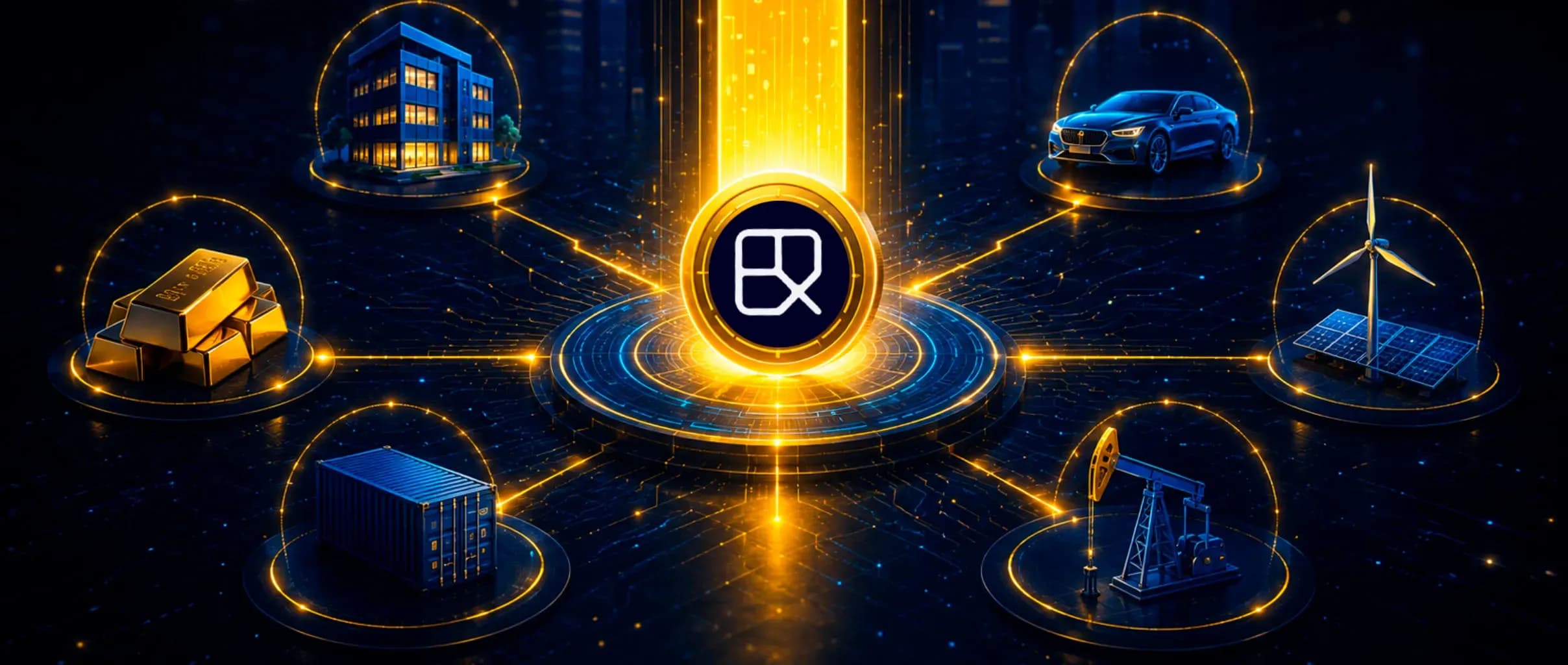
RWA (Real-World Assets) are tokenized versions of real-world assets: currencies, bonds, equities, commodities, or contractual receivables. Technically, these are digital tokens on a blockchain. They grant the holder ownership rights or claims on a real-world asset.
Rights to the asset are recorded in a distributed ledger—the blockchain. This enables:
transferring an asset from one participant to another within minutes;
dividing it into fractions;
using it as collateral in smart contracts without manual approval of each transaction.
RWA are not cryptocurrencies. Bitcoin or Ether are assets that exist only in digital form. RWA always have underlying real-world value: funds in accounts, government bonds, gold in storage, or payment rights under an export contract.
How the RWA Market Is Growing: From Billions to Trillions
At the beginning of 2023, the RWA market barely reached $1.5 billion. Today, on public blockchains, excluding stablecoins, the volume of such assets has exceeded $30 billion. This represents impressive growth of nearly 20x over three years.
But far more important than today's figures are the projections. According to Boston Consulting Group, the market could reach $88 trillion by 2035—approximately 16% of all globally investable assets. Other analysts offer more conservative estimates: from $2–4 trillion (McKinsey) to $9 trillion (BCG) by 2030.
However, I see no point in debating the numbers. Whatever the pace, the direction is clear: capital is moving toward digital instruments backed by real assets.
RWA Market Structure in 2026
Today, the lion's share of this market consists of tokenized U.S. Treasury bonds. This represents $16 billion out of $30 billion, or 55% of all RWA on public blockchains.
Investors use them as a digital equivalent of cash. Such a token can be held while earning yield, transferred to a counterparty for settlement, or used as collateral.
2. In second place are tokenized commodities, primarily gold. According to CoinGecko, the market capitalization stands at $5–6 billion, and spot trading volume for tokenized gold in Q1 2026 reached $91 billion. This exceeds the volume for all of 2025. The market is buying and selling gold-backed tokens at a phenomenal speed—a sign of extremely high asset demand.
3. Tokenized loans and private debt constitute the third-largest segment. This refers to the transfer of accounts receivable, promissory notes, and other debt instruments onto the blockchain.
This segment, in my view, holds the greatest potential for trade finance and export contract operations.
What Holds the Market Back: Regulation and Liquidity
A survey of 150 market operators conducted by the Centrifuge platform in early 2026 shows:
76% of respondents cite regulatory uncertainty and insufficient liquidity as the primary barriers;
86% of operators believe that scaling token distribution is more important today than launching new products.
This means that technology is no longer a constraint. There are no issues with creating a token. The main challenge is finding buyers for it and ensuring a secondary market.
I observe the same pattern in my own practice. An exporter is ready to tokenize an invoice—an investor is ready to purchase it. But what is needed is infrastructure that connects them within a unified legal framework, with clear rules and fast settlement.
Who Is Driving the Market: From Pilot Projects to Full-Scale Infrastructure
The largest RWA market players have already moved beyond experiments. In July 2026, DTCC (The Depository Trust & Clearing Corporation) successfully conducted live transactions with tokenized assets within its operational environment. This is a global clearing giant that processes trillions of dollars in transactions daily.
On July 15, 2026, transactions with tokenized assets via DTCC were executed by more than 30 institutional participants, including:
BlackRock, the world's largest asset manager;
Goldman Sachs, a leading investment bank;
J.P. Morgan, a global financial conglomerate;
Nasdaq, the second-largest stock exchange in the world by market capitalization.
These figures demonstrate that tokenization is no longer a startup game. The largest banks and asset managers are building their products on it.
What This Means for Corporate Treasury
Access to liquidity is no longer tied to banking limits. For me, this is the key takeaway as a project lead at Edenex, working with exporters and suppliers.
Companies that hold real assets (invoices, contracts, inventory) can now convert them into digital tokens and offer them to investors worldwide. This is not a replacement for banks—they remain arrangers, guarantors, and issuers. But an additional funding channel emerges for transactions that traditional banks cannot service quickly enough.
However, I would caution against excessive optimism. Tokenization does not create liquidity out of thin air, and a token is not always equivalent to cash. For an investor, it is crucial to understand:
the legal structure of the asset;
who holds it;
how settlement occurs;
what happens in the event of default.
In this sense, RWA is not a revolution but an evolution: familiar financial instruments packaged in a new technological wrapper.
Conclusion
I believe the next 2–3 years will be devoted not to creating new tokens, but to building out infrastructure: legal frameworks, compliance checks, monitoring systems, and secondary markets.
Tokenizing an invoice is only the first step. The second is to ensure that the token can be sold, pledged, or exchanged for cash at any time, without paperwork and with clear legal protection.
This is exactly what we do at Edenex—building infrastructure that connects exporters with global liquidity pools through contract tokenization. Such solutions work where classical banks and factoring providers, for objective reasons, cannot offer acceptable speed and cost.
Sergey Abisher, Head of New Projects at a company developing digital solutions for international trade and trade finance.