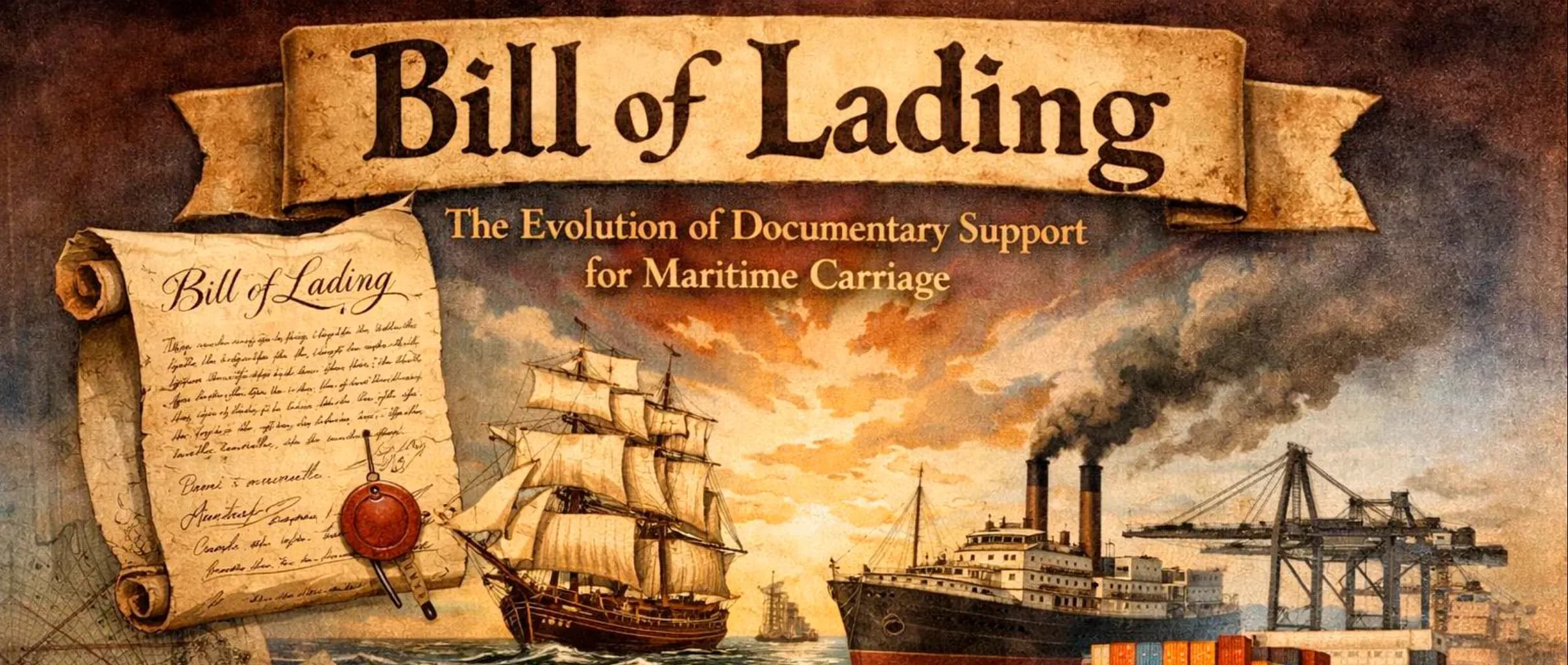
created by Gpt
Evolution of Bill of Lading: From Receipt to Digital Asset
The bill of lading is centuries old but still relevant today. Tracing the document's journey from Venetian ship logs to smart contracts: why carriers lost the right to "navigation error" and how a single 2023 UK law sparked the e-BL revolution.

Bill of Lading: The Evolution of Documentary Support for Maritime Carriage
Introduction
The bill of lading is a legal instrument with no real equivalent. Its evolution reflects a long journey from a basic need to a serious working tool in international trade and shipping. From a simple cargo receipt to a legally complex document combining the functions of a negotiable instrument, a contract of carriage proof, and evidence of cargo receipt — the B/L has come a long way. Each stage was shaped by the demands of business and the players who keep it moving (banks, insurers, customs, arbitrators). Today, in an era of digital transformation and patchy legal frameworks, the bill of lading remains front and center in debates over the future of global cargo transport.
Genesis of the Document: From Ship’s Log to Negotiability
The B/L’s roots go back to the Mediterranean trading republics — Venice, Genoa, and Pisa. In the 11th–13th centuries, when merchants stopped traveling with their goods and started sending them with trusted agents, a real need emerged to pin down ownership of faraway cargo. The first step toward the B/L was the ship’s register — a logbook where the captain, under the clerk’s watchful eye, recorded goods taken onboard. This duty was codified in medieval legal sources like Spain’s *Fuero Real* (1255) and Italy’s *Ordinance of Trani* (1063). Fun fact: forging entries in the ship’s register was punished brutally — up to amputation — which shows how seriously they took this document even back then.
Copies of the register were later given to cargo owners as proof of receipt. The term's etymology says it all: from Spanish *conocimiento* (proof, receipt) came French *connaissement* and German *Konnossement* — pointing to the document’s original job as a simple acknowledgment. But in English law, which largely shaped the modern B/L, the document took on a broader role. By the 17th century, its third and key function — negotiability — was firmly established. Legal recognition of the B/L as a negotiable instrument was nailed down by the Carriers' Act 1662 (under Charles II) and subsequent rulings by the famous Lord Mansfield, who recognized that rights in the cargo could be transferred by endorsing the back of the B/L.
The practice of issuing three original B/Ls also has deep roots. It was written into Louis XIV’s 1681 ordinance regulating maritime trade in France. One copy went to the consignee by mail, another to the ship’s captain, and the third stayed with the shipper. That setup minimized the risk of losing the document in transit. The oldest surviving B/L — held in private collections — is dated around 1680, confirming how standard the practice had become.
Legal Codification and the First International Regimes
The 18th–19th centuries saw the B/L lock in its three classic functions, still recognized by modern law. First, it’s a carrier’s receipt for the cargo, confirming quantity, condition, and visible marks. Second, it’s evidence of the contract of carriage — and when it conflicts with a charterparty, the B/L terms usually take priority. Third, it’s a document of title, letting you dispose of the cargo without physically moving it. That last function made the B/L indispensable: trading paper turned out to be way faster and more convenient than moving goods themselves.
But by the early 20th century, the lack of uniform rules led to serious abuse by carriers. Big shipping lines started stuffing their B/L forms with one-sided clauses (paramount clauses) that basically let them off the hook for cargo damage. This period is known as "carrier protectionism," and the backlash led directly to the first international convention. On August 25, 1924, the International Convention for the Unification of Certain Rules of Law relating to Bills of Lading — better known as the Hague Rules — was signed in Brussels.
The Hague Rules set a minimum standard of carrier liability: a duty to exercise due diligence to make the vessel seaworthy, plus a liability limit of £100 per package or unit. That said, the convention still gave carriers a long list of exceptions — navigational error, fire, force majeure, you name it. In 1968, the Visby Protocol upgraded the system, doubling liability limits to 666.67 SDR per package and extending the convention to cover claims against agents and stevedores.
More radical changes came with the Hamburg Rules of 1978, adopted under UNCITRAL’s umbrella. Those rules scrapped the navigational error exemption, raised liability limits to 835 SDR per package, and introduced a presumption of carrier fault. But the Hamburg Rules never got ratified by the major maritime powers — the US, the UK, China, and most of Northern Europe. So today, the Hague-Visby Rules dominate international maritime carriage, with over 90 countries effectively on board.
Technological Transformation: The Electronic Bill of Lading
The digital economy has thrown a fundamental question at maritime law: can an electronic bill of lading carry the same legal weight as a paper one? The core issue is singularity — uniqueness. A paper B/L exists as a single original, which prevents double-selling the cargo. A digital file, on the other hand, can be copied and handed to multiple people at once — and that opens the door to fraud.
The solution came from two angles: tokenization (creating a unique digital token that exists in a single copy) and the adoption of the UNCITRAL Model Law on Electronic Transferable Records (MLETR) in 2017. The MLETR established the principle of functional equivalence: an electronic record has the same legal effect as a paper document, provided the method for identifying and controlling that record is reliable.
Current Challenges and Recent Regulatory Changes
The 2025–2026 period has seen changes that are reshaping the B/L legal landscape. Unlike earlier harmonization through multilateral conventions, the trend now is toward fragmented unification via national laws and bilateral deals.
The biggest game-changer? The UK’s Electronic Trade Documents Act, which received royal assent in July 2023 and came into force on September 20, 2023. This Act goes beyond MLETR: it says that electronic trade documents — including B/Ls — are automatically treated as the legal equivalent of paper ones, without needing a separate agreement between the parties. For London, still the world’s hub for maritime arbitration, this is massive. The LMAA now recognizes electronic B/Ls as full-blown documents of title, even if the other side never explicitly signed a digital agreement.
China keeps building out its e-BL infrastructure. Platforms like TradeGo and GSBN are already in commercial operation. Government policy is pushing blockchain integration to ensure authenticity and immutability of electronic transport documents — speeding up customs clearance and making it easier to access bank letters of credit. That said, the legal status of e-BLs in China can still vary by port and transaction type; recognition isn’t yet universal or uniform.
India has taken a big legislative step with the Merchant Shipping Act 2025, which replaces the 1958 Act. This law creates a legal framework for digitizing shipping documentation, including e-BLs. No mandatory mandate yet, but ports like Nhava Sheva (JNPT), Mundra, and Chennai are actively rolling out digital systems via the ICEGATE portal and e-Sanchit — significantly speeding up customs clearance and cutting paper use.
The EU’s eFTI Regulation is in active implementation mode. The timeline:
* By December 2025 – European Commission to adopt final specs for eFTI platforms.
* From January 2026 – EU member states’ authorities may start accepting data from certified eFTI platforms.
* July 9, 2027 – Full application of the eFTI Regulation: all competent authorities must accept electronic freight information via certified platforms.
Admittedly, this regulation doesn’t directly replace the B/L as a document of title. But it removes a critical barrier to digitization by requiring EU customs to accept electronic transport documents — creating the ecosystem needed for a future paperless transition.
Finally, a major trend is the rise of bilateral and multilateral initiatives for mutual recognition of electronic B/Ls. The Asia-Pacific region is especially active: financial and tech institutions — including in Hong Kong and Shanghai — are exploring blockchain applications for cross-border trade. Pilot projects using platforms like CargoX and other blockchain systems aim to build immutable, traceable infrastructure for e-BL exchange, setting an important precedent for the region’s digital ecosystem.
Future Regulation and Unresolved Issues
Despite all the progress lately, some fundamental problems remain. The Rotterdam Rules — adopted back in 2008 and extending coverage to the whole door-to-door multimodal carriage period — still haven’t entered into force. The main roadblock? The US and EU insist on keeping the navigational error exemption, a principle inherited from the Hague Rules. Shippers, by contrast, see that as an anachronism in an age of GPS and AIS. You can’t really argue that a navigation mistake is unavoidable when the tech to prevent it is widely available.
Another issue worth highlighting: the legal status of e-BLs as collateral. In traditional banking, B/Ls back letters of credit. But plenty of banks — especially in developing economies — are still reluctant to accept e-BLs for that purpose, given lingering risks and a lack of consistent case law.
Conclusion
The bill of lading has come a long way — from a handwritten entry in a ship’s log to a legally sophisticated digital asset. Its legal evolution has consistently chipped away at freedom of contract to protect cargo owners — from *caveat emptor* (buyer beware) toward recognizing the carrier’s fiduciary duty to act in good faith. The technological evolution, peaking in the mid-2020s, has shown that the main barrier to digitization isn’t technical — it’s the lack of global harmony in case law and the differences between national legal systems. Still, with the UK’s Electronic Trade Documents Act, China’s active digital platform development, and India’s legislative nod to e-BLs, the international trading community has taken a real step toward full digitization of maritime carriage.
Author’s take: Should we expect the B/L to die out anytime soon? I don’t think so. The bill of lading as a legal construct is surprisingly resilient. Technology alone won’t replace it — what will is the disappearance of that core need: to transfer title to goods in transit without physically handing over the cargo itself. That could happen when supply chains become fully automated with IoT tags and smart contracts — where the goods themselves "announce" the change of ownership. But that’s decades away, if not half a century. So the B/L won’t disappear — it will mutate. From paper to electronic, from document to distributed ledger record — but it will remain that elegant tool that decouples the movement of goods from the transfer of title across time and space. As long as international trade relies on trust between strangers — backed by a document — we’ll still need the bill of lading. It’s not immortal, but its era definitely isn’t ending tomorrow.