generated gpt
Digital Letters of Credit and Bank Guarantees: Automating Trade Finance via Smart Contracts
Smart contracts automate letters of credit & bank guarantees — cutting fees, errors, and settlement times from days to T+0.

In 2026, the global digital economy is estimated at approximately $20-28 trillion, accounting for 17-22% of global GDP. It is growing three times faster than the overall economy, notes the Digital Cooperation Organization (DCO).
This demonstrates that by 2026, nearly the entire global economy has transitioned to digital. However, documentary trade finance (Letters of Credit — LC and Bank Guarantees — BG) stands out against this general backdrop. In 2026, letters of credit and bank guarantees still operate under the "classic model": with paper documents, manual verification, and bank clerks.
The cost of this archaism is high. According to the International Chamber of Commerce (ICC):
65-80% of documents under letters of credit contain discrepancies upon first submission;
each discrepancy triggers manual reconciliation and delays payment by 5-15 days;
bank fees consume up to 1-3% of the contract value;
the importer's funds are frozen for the entire transit period of the cargo.
Such a model poorly aligns with the high-speed requirements dictated by modern supply chains.
Smart contracts could be the solution. Under the new model, bank clerks will no longer have to spend hours manually reviewing paper documents and processing transactions. The code itself verifies documents and transfers funds as soon as all conditions are met.
Anatomy of TradFi Inefficiency: Why the Paper Letter of Credit Is Dying
1. The main problem is discrepancies in documents: incorrect amount, mismatched shipment date, and so on. Any minor issue — and the bank returns the documents for revision. Each such reconciliation cycle delays payment by 5-15 days. For business, this means funds are stuck in the banking system while the goods have already been shipped.
2. High cost. The classic model involves:
the buyer's bank (issuing bank);
the seller's bank (advising/nominated bank);
if the transaction is international and complex, a confirming bank is also involved.
Each of them charges fees. In total, they consume up to 1-3% of the transaction value. According to McKinsey estimates, migrating B2B payments to blockchain can save up to 3.4% in fees. For a $1 million transaction, that is $34,000 in pure losses. With dozens of such deals per year, the losses run into millions. That is why banks and their clients are seeking alternatives.
An additional drawback of the classic model: the importer's working capital is frozen for the entire cargo transit period, sometimes 2-3 months. They cannot use those funds for their own needs, which also incurs losses.
How DLT-Based Letters of Credit and Guarantees Work on Smart Contracts
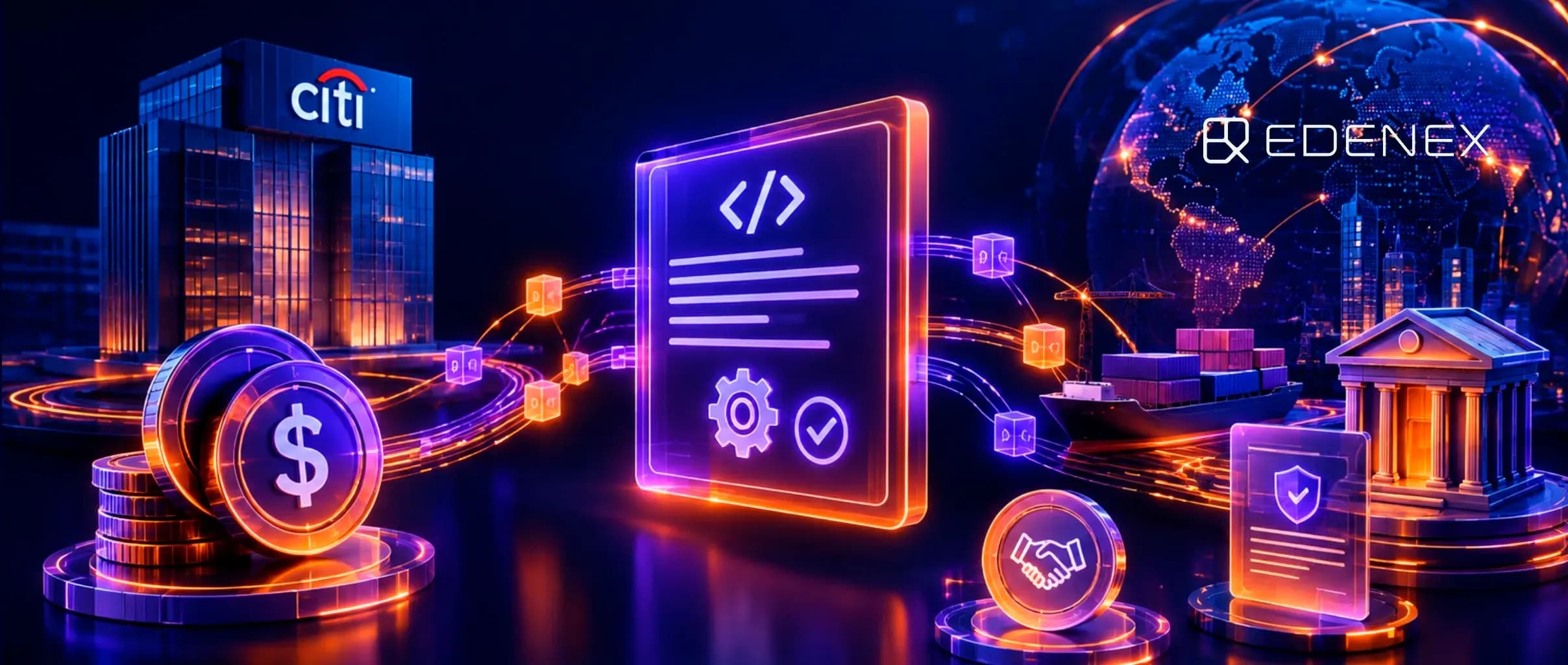
Programmable conditional escrow — essentially a digital escrow that uses a smart contract. It rigidly codifies all transaction terms: amount, deadlines, and the list of documents to be provided. These conditions cannot be unilaterally altered. In 2025, Standard Chartered successfully executed a trade finance transaction using a blockchain platform where a smart contract automatically managed the letter of credit execution. J.P. Morgan is testing tokenized deposits to accelerate cross-border payments and settlements.
Integration with electronic bills of lading (eBL) and oracles is employed. As soon as the shipping line uploads the electronic bill of lading to the distributed ledger, the smart contract automatically validates it.
Atomic settlement (T+0). If the algorithm confirms data matching — weight, port of discharge, nomenclature — the payment is automatically transferred to the exporter. The role of the bank compliance officer is performed by code, which accelerates the process and reduces costs.
The creation of a convenient infrastructure plays a critically important role. In 2026, five electronic bill of lading platforms — CargoX, edoxOnline, TradeGo, WaveBL, and eTEU — became interoperable with one another. This became possible thanks to a unified technical and legal standard. It was developed by the Digital Container Shipping Association (DCSA) and approved by the International Group of P&I Clubs, which insures carriers' liability.
Previously, an electronic bill of lading issued on one platform remained trapped within it. All transaction participants — carrier, shipper, bank, buyer — had to operate within a single system. If any party used a different platform, they had to revert to paper.
According to FIT Alliance data, 71% of market participants cited lack of interoperability as the main barrier to transitioning to electronic bills of lading. The new standard resolves this issue.
Evolution of Bank Guarantees: Tokenization of Collateral
Tokenized collateral eliminates fraud. In the traditional system, bank guarantees are often forged or issued against collateral of "hot air" — without real backing. In a DLT environment, the guarantee is issued as an immutable token to which on-chain collateral is rigidly attached — for example, tokenized treasury bills or stablecoins.
Distributed Ledger Technology (DLT) implies that information is stored simultaneously across multiple network participants, rather than on a single central computer. Data cannot be forged or retroactively altered: every record is confirmed by other participants.
Major players are testing this principle. In April 2026, OKX, BlackRock, and Standard Chartered launched a joint platform. Tokenized BlackRock funds are used as collateral for trade operations, while Standard Chartered acts as a regulated custodian holding the collateral. This is the first such arrangement involving a global systemically important bank.
Automatic execution. In the event of a contract breach, the beneficiary initiates a smart contract call, which instantly and unconditionally transfers the guarantee amount — bypassing lengthy judicial and banking proceedings.
| Criterion | Traditional Bank Letter of Credit/Guarantee | Digital DLT Letter of Credit on Smart Contracts |
|---|---|---|
| Issuance speed | Days-weeks (manual review) | Minutes-hours (automated verification) |
| Error rate (discrepancies) | 65-80% upon first submission | Minimal (code does not allow mismatches) |
| Service cost (fees) | 1-3% of contract value | 0.15-0.3% |
| Settlement speed (funds release) | 5-15 days (reconciliation of discrepancies) | T+0 (automatic settlement) |
| Risk of document forgery | High (paper originals) | Low (cryptographic verification) |
Edenex RWA Infrastructure: Trade Finance Without Bank Bureaucracy
Smart contracts have moved Trade Finance out of the jurisdiction of slow bank back-offices. But even after that, three problems remain:
integration with existing banking systems: to migrate to a DLT letter of credit, companies need to synchronize it with their ERP, documents, and compliance procedures, which can take up to a year and be costly;
regulatory uncertainty: not all countries recognize electronic documents, so companies are forced to maintain a hybrid system — partly digital, partly paper;
access to liquidity for companies that are ready for digital but lack access to bank credit lines.
There are solutions for these problems as well — digital platforms. For example, Edenex shifts foreign trade contracts to digital rails, using smart contracts to create secure RWA transactions that replace archaic letters of credit.
As a result, exporters and importers gain a reliable conditional escrow mechanism, integration with electronic document workflow, and direct access to institutional liquidity without hidden bank fees.
The process is fully automated: document verification, delivery confirmation via oracles, and instant settlement — everything happens in code, without bank clerks. For the investor, this is an asset with a transparent structure: the smart contract protects their rights and eliminates the risk of manipulation.
FAQ: Frequently Asked Questions
Do digital letters of credit based on smart contracts have legal force in 2026?
Yes. A key role is played by the adoption of the UNCITRAL (United Nations Commission on International Trade Law) Model Law on Electronic Transferable Records — MLETR. As of mid-2026, its principles have been implemented in the United Kingdom, Singapore, the UAE, and France. China adopted a law for electronic bills of lading in 2025. Documents created in accordance with UCP 600 standards have full legal force.
What happens if a bug is found in a smart contract?
Smart contracts undergo multi-level audits before deployment. Leading platforms use a hybrid model — automatic execution plus override mechanisms for manual intervention in exceptional cases.
Do transaction parties need to use cryptocurrency for settlements under a DLT letter of credit?
No. Settlements are conducted in regulated stablecoins or tokenized fiat. As of mid-2026, the volume of B2B payments via stablecoins exceeded $226 billion and is growing at 30-40% annually.