Сгенерировано Chatgpt
Three Principles of Islamic Finance
How can a CFO structure transactions without interest-based lending and gain access to Middle Eastern capital? We examine the mechanics and compliance framework.

Restrictions imposed by Sharia norms on the banking and financial sectors.
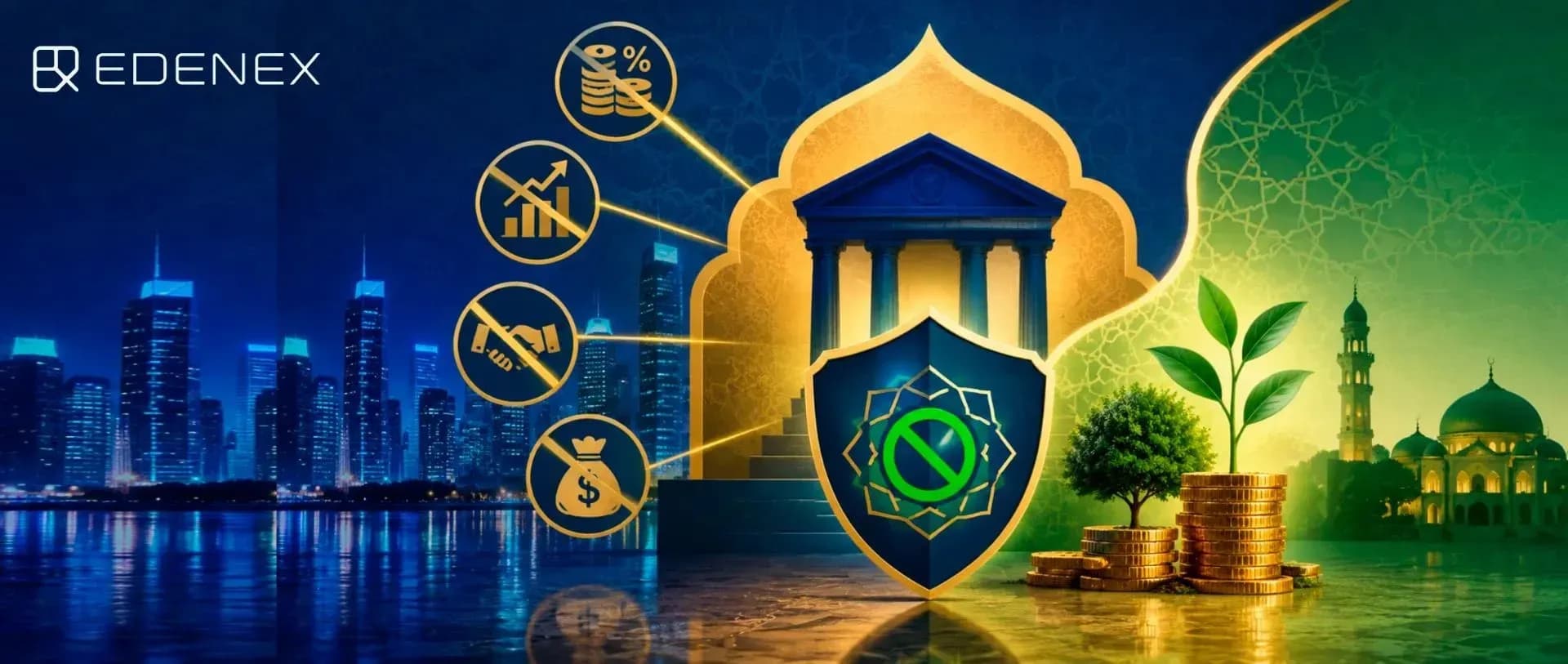
Islamic banking is a distinct system of financial relations built on the principles of Sharia:
prohibition of interest-based lending (Riba);
prohibition of speculation (Gharar);
ensuring transactions are backed by real assets.
Contemporary Islamic banking emerged in 1963 when the Egyptian bank Mit Ghamr began issuing interest-free loans. Initially, it was popular only among adherents of Islam, for whom compliance with religious norms was of paramount importance. However, the landscape is currently undergoing transformation.
According to S&P Global, by 2026 the volume of global Islamic financial assets will exceed $6.5 trillion. Moreover, over the past five years, it has grown by 80%.
Currently, Islamic banking accounts for approximately 1–2% of global financial assets. While this figure appears modest, given its rapid growth trajectory, experts project its increase to 3% over the next decade.
Such a substantial pool of liquidity is already attracting the attention of London, Luxembourg, CIS countries, Asia, and other non-Muslim markets. To penetrate these markets, the industry is undergoing a rebranding exercise. Religious terminology is receding into the background, being supplanted by terms such as "ethical financing," "risk-sharing," and "asset-backed investments."
Many investors are drawn to Islamic banking by the assurance that their capital will be directed towards "socially beneficial purposes" and will not be associated with the financing of alcohol or gambling.
Convergence of ESG and Islamic Finance
The principles of Islamic finance (Fiqh al-Mu'amalat) cannot be characterised as entirely novel to European and Asian markets. Numerous Sharia norms in the financial domain align seamlessly with contemporary ESG investment requirements. This is not a fortuitous coincidence — these instruments share a similar underlying logic.
1. Riba: funds are not lent at interest. Instead, transactions are structured through the purchase and sale of goods, leasing (Ijarah), or equity participation in a business (Musharaka). Consequently, the bank generates revenue not from interest but from trade margins or lease payments.
2. Gharar: prohibition of uncertainty and speculation. Transactions must be transparent and backed by a tangible asset — equipment, real estate, or commodities. Financing of abstract or speculative undertakings is impermissible.
3. Haram: prohibition of financing harmful industries (alcohol, tobacco, weapons, gambling). This fully aligns with the requirements of socially responsible investors. Consequently, Islamic instruments (Sukuk) constitute green financing that naturally fits within ESG portfolios.
The growing popularity of green sukuk (ESG sukuk) corroborates this trend. For instance, in November 2025, developer Binghatti issued a green sukuk worth $500 million, which attracted subscription applications totalling $2.1 billion.
Certain banks operate "Islamic windows" — dedicated departments offering financial services in accordance with Sharia norms. Examples include HSBC, ABN Amro, UBS, Citigroup, and Deutsche Bank.
Islamic Finance Instruments in the Corporate CFO's Lexicon
Let us examine how the exotic terminology of ethical banking translates into the language of standard corporate finance.
| Sharia Term | Translation for CFO | Mechanics |
|---|---|---|
| Murabaha | Cost-plus trade financing | The bank purchases the goods and resells them to the client at a fixed markup. Functions as an alternative to working capital loans. |
| Sukuk | Asset-backed securities | Issuance of certificates granting the right to a share in the income derived from the underlying asset. In 2025, the aggregate volume of all sukuk issuances exceeded $1 trillion, according to industry publication IFN Investor. |
| Ijarah | Finance or operating lease | Asset leasing with a purchase option. Identical to standard leasing, but devoid of interest-based components. |
| Musharaka / Mudaraba | Joint venture or project financing | Profit-and-loss sharing. In such partnerships, one party contributes capital, while the other contributes managerial expertise. |
According to IFN Investor, as of 2025 there were 409 Islamic funds globally investing in debt instruments (bonds and their equivalents), managing $26.5 billion in assets. S&P Global projects that the sukuk (Islamic bond) market will reach $270–280 billion in 2026.
Why Should a Non-Muslim Company Access Ethical Financing?
Debt portfolio diversification. Halal investments enable a company to reduce its reliance on conventional bank loans and traditional bonds. This is particularly relevant when interest rates are elevated or subject to unpredictable fluctuations.
Access to new capital. Through ethical financing, a company gains entry to major investors from the Gulf States and Islamic funds, which are constitutionally precluded from purchasing conventional bonds. The influx of alternative liquidity from Muslim-majority countries constitutes the primary growth driver for this sector.
Resilience. Given that such transactions are strictly tied to real assets, they are less susceptible to market bubbles, speculative activity, and key rate volatility.
Importantly, resilience does not preclude growth. In 2025, Islamic equities (S&P Global BMI Shariah Index) appreciated by 16% — nearly matching the US S&P 500, which gained 17.9%.
Сompliance Checklist: Structuring a Transaction and Navigating Compliance
1. Segregate accounts. Funds obtained through ethical financing must be held separately from those associated with conventional interest-bearing loans. This is particularly critical for companies employing both types of instruments.
2. Verify the existence of a real asset. The transaction must be underpinned by a tangible asset — a building, equipment, goods already shipped or in transit, etc. Without such collateral, the transaction cannot be executed.
3. Reconcile Sharia requirements with the legislation of the jurisdiction where the transaction is registered. Documentation is often prepared in accordance with AAOIFI (Accounting and Auditing Organization for Islamic Financial Institutions) standards, which function analogously to international financial reporting standard-setting bodies.
4. Audit supply chains. It is necessary to confirm that the company's business is not associated with Sharia-prohibited sectors (alcohol, pork, gambling, weapons).
5. Ensure that the company's debt burden does not exceed the permissible threshold — typically no more than 30% of its market capitalisation. Should this requirement be breached, the Riba prohibition (interest-free lending) is triggered, and both the financing entity and the financed object must remain compliant.
Frequently Asked Questions
Question 1: Can a secular company or non-Muslim state issue sukuk? Yes:
The United Kingdom, Luxembourg, and Hong Kong have successfully issued sovereign sukuk;
In Central Asia, the first Sharia-compliant ETF — ITS Shariah ETF — was launched in Kazakhstan in January 2025;
In 2026, the first certificate of compliance with Islamic ethics was issued in Russia for a corporate banking product.
Core principle: sukuk is a financial instrument, not a religious practice, and it operates within any legal framework provided the requirements regarding the underlying asset and structure are satisfied.
Question 2: Is ethical financing more expensive than conventional lending?
The profit rate itself is competitive. It is often benchmarked against reference rates such as SOFR (Secured Overnight Financing Rate) — the benchmark interest rate reflecting the cost of overnight borrowing collateralised by US Treasury securities.
The Binghatti green sukuk was priced at 7.75% against an initial guidance of 8.125%. However, upfront legal structuring may be costlier due to the complexities of Sharia compliance.
Over the long term, access to a broader investor base may offset these expenses.
Question 3: How does ethical (Islamic) financing differ from a standard green loan?
A green loan controls the purpose of fund utilisation — proceeds must be directed toward environmental projects. Ethical (Islamic) financing strictly dictates the transaction mechanics themselves: the absence of interest-based lending, mandatory risk-sharing, and the presence of a real asset.
Importantly, the instruments can be combined: a green sukuk simultaneously functions as an ESG instrument while remaining fully Sharia-compliant.