Small Open Economy Vulnerability: Why Portugal’s Exports Critically Depend on Alternative Trade Finance
Discover why tokenized real-world assets (RWA) are emerging as the only viable bridge to global private capital—bypassing local credit rationing, 120-day payment cycles, and collateral demands that lock SMEs out of growth.

A closed economy model implies that a country produces and consumes goods in roughly equal measure, with minimal exports and imports. An open economy, by contrast, actively participates in global flows of goods, services, and capital—through trade, international investment, and labor mobility.
Portugal is a classic example of a small open economy (SOE). Its foreign trade volume accounts for a massive share of GDP—between 86–93% in 2023–2025, according to research firm MacroTrends. Exports in 2025 accounted for approximately 45% of GDP.
This means Portugal’s economic health is critically dependent on the uninterrupted flow of export shipments. Disruptions in logistics chains or shortages in trade financing directly translate into slower economic growth, lower tax revenues, and rising unemployment in export-oriented sectors.
However, the ECB’s tight monetary conditions in recent years have led to a contraction of limits on traditional trade finance:
In 2023–2025, the ECB held rates at historic highs to curb inflation, which had reached double-digit levels in 2022. By mid‑2026, the European Central Bank had initiated another tightening cycle, raising the deposit rate to 2.25%.
Balance sheet reduction (quantitative tightening). Since March 2023, the ECB has ceased full reinvestment of proceeds from its bond portfolios. The market is losing its largest and most predictable buyer.
Under such tight conditions, banks protect their capital, and regional exporters are left without working capital. The global trade finance gap in 2025 was estimated at $2.5 trillion, according to the Asian Development Bank (ADB). For countries like Portugal, this issue is particularly acute, despite their EU membership.
A 2024 study by the Bank of Portugal confirms that access to credit is a key barrier to exports, especially for micro, small, and medium-sized enterprises (MSMEs). Firms that gained such access were 12% more likely to start exporting compared to those that did not.
For some, credit enabled them to upgrade export product quality—for example, producing Extra Virgin olive oil and wine with Protected Designation of Origin (DOP) status. For producers, this means entry into higher-margin markets. For the market, it translates into higher export revenues.
Anatomy of Vulnerability: Why Traditional Banking Fails Exporters in an SOE
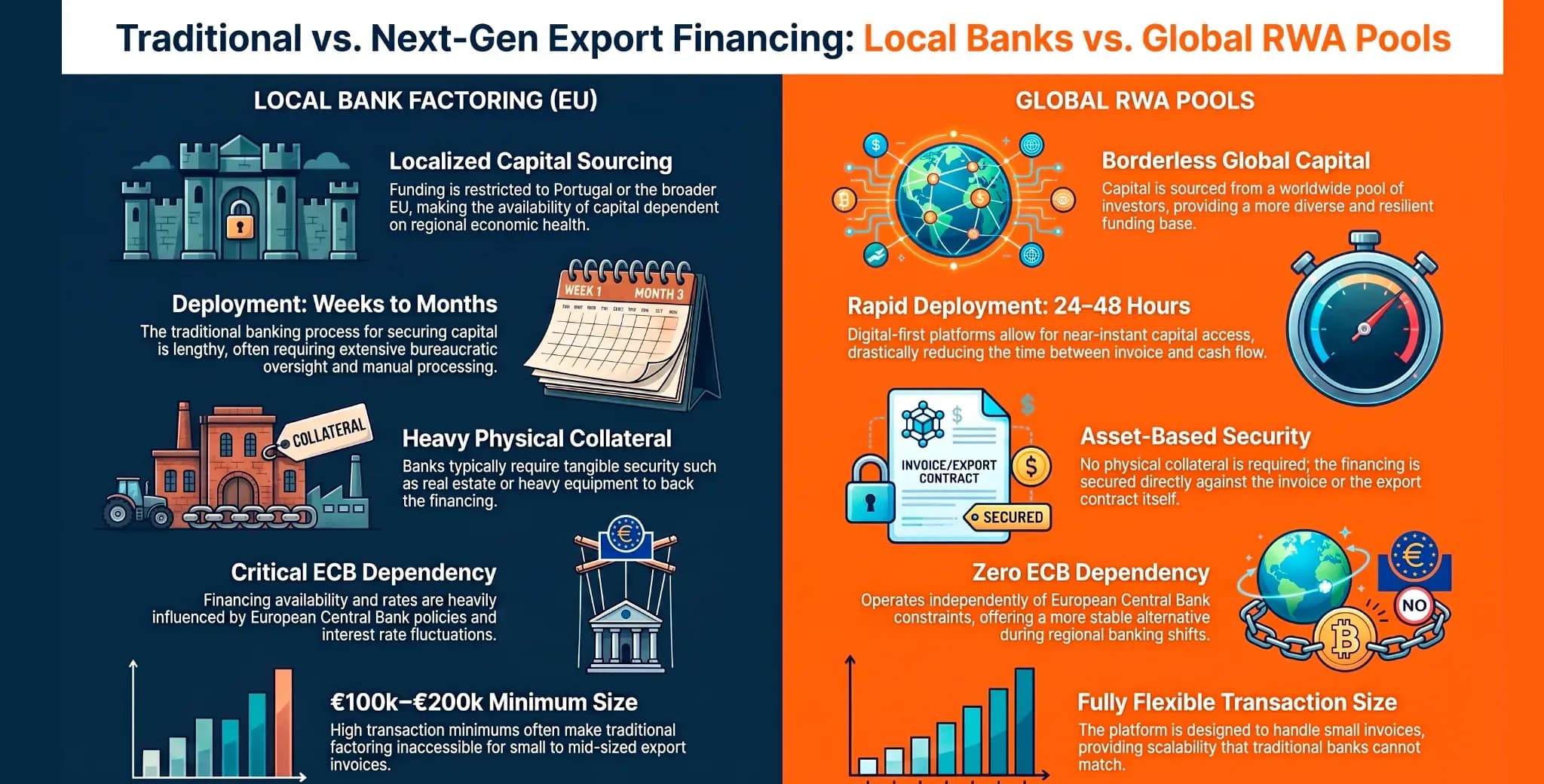
The first reason banks often reject exporters is credit rationing. When economic shocks occur and the ECB tightens policy, local banks do not merely raise rates for SMEs—they shut off access to credit entirely. This creates a severe cash flow gap.
The second reason is dependency on long payment cycles. Portuguese exporters operate with payment deferrals of 60–120 days. This applies across all key industries. Large retail chains and corporations can go even further, imposing payment terms of up to 6 months on suppliers.
Without accessible factoring or credit lines, businesses fall into a trap: goods are shipped, but payment arrives with a significant delay. Throughout this period, working capital remains frozen in accounts receivable.
A Bank of Portugal study showed that tighter banking regulation under international Basel III rules led to an 8% reduction in Portuguese exports to high-credit-risk countries.
Trade Finance Gap in Southern Europe: The Price of Banking Monopoly
Local exporters struggle to secure funding because banks impose conditions that businesses cannot meet.
Hard collateral.
Banks demand real estate or equipment as security. But a textile mill or cork producer typically holds few such assets.
Paperwork bottlenecks.
Counterparty and document checks take weeks—sometimes months. By the time the bank finishes due diligence, the client has already found another supplier.
Expensive letters of credit.
If the buyer is outside the EU, cross-border settlement fees skyrocket.
Rejection of small-ticket deals.
Banks avoid contracts below €100–200k, as due diligence consumes the entire margin.
But the core issue is liquidity isolation. Portuguese businesses are locked within the local banking system. If banks in Lisbon face a liquidity crunch or tighten rules, the exporter cannot quickly refinance in Asia or the US. There is simply no mechanism that would allow a Portuguese producer to tap into global capital pools.
As early as 2023, the Bank of Portugal recorded a net deficit in bank financing, pointing to a structural dependency on foreign creditors.
The hard truth:
In 2026, exporters from Portugal and other SOEs face extreme difficulty surviving without bank lending—yet obtaining it is disastrously challenging. This makes alternative financing an inevitable necessity.
RWA and Tokenization: How SOEs Gain Access to Global Capital
Tokenization of real-world assets (RWA) is one of the few available pathways to detach an export contract from local jurisdiction. Converting accounts receivable into a digital token moves the asset onto the global private credit market. As a result, investors from Asia, the Middle East, and the US see a Portuguese invoice as a transparent, collateralized asset.
The market is expanding rapidly: according to Binance Research, by June 2026, the volume of active tokenized RWAs had grown 589% since the start of 2025, reaching $32 billion. Bernstein analysts call 2026 the beginning of a tokenization "supercycle."
If a Portuguese footwear manufacturer’s invoice to a US buyer is tokenized, a smart contract converts the receivable into a token. Liquidity for that smart contract is provided by institutional investors from around the world within 24–48 hours, bypassing the bureaucracy of Portuguese or US correspondent banks.
Tokenized US Treasury bonds have become the largest market driver—their volume exceeded $16 billion, accounting for approximately 55% of the entire RWA market. This confirms that tokenization is a viable method for turning any real-world asset into a token.
For exporters in small open economies, this means liquidity shortages are no longer fatal—because access to global capital becomes a reality.
Edenex Solutions for Export-Oriented Businesses
Global trade demands global liquidity, so small open economies need instruments that are not subject to the whims of local banking syndicates.
The Edenex platform provides infrastructure for tokenizing export contracts, connecting independent trading companies with global pools of alternative liquidity. It tokenizes invoices and trade contracts, giving exporters rapid access to working capital—without collateral and without being tied to regional bank limits. 80% of checks are automated, ensuring high processing speed.
All transactions undergo end-to-end institutional-grade KYC/AML compliance. Corporate treasuries receive a complete closing document package—all paperwork required for regulators, auditors, and internal reporting.
A tokenized transaction is not a "grey area": it is fully documented, compliant with European and international standards, and can be presented in any audit or regulatory review.
FAQ – Frequently Asked Questions
1. What is specific about trade finance for SOE-format countries?
The export-to-GDP ratio in SOEs exceeds 80–100%, making the economy critically dependent on uninterrupted export flows. Any supply chain disruption or reduction in bank limits immediately affects the entire economy—not just a single company. Meanwhile, local banks cannot provide the required financing volume due to limited capital bases and regulatory constraints.
2. How has the implementation of the European MiCA regulation (transition period ended in July 2026) affected the use of RWA in settlements?
The full entry into force of MiCA as of July 2026 created a unified legal regime for crypto-assets in the EU, including tokenized real-world assets. For RWA platforms, this means clear licensing rules, transparency requirements, and reserve obligations—increasing institutional investor confidence. For SOE exporters, it reduces legal risks when using tokenized invoices in cross-border trade.
3. Can an Asian investor legally fund a Portuguese invoice via a smart contract?
Yes. Tokenization enables accounts receivable to be represented as a digital asset accessible on global markets, regardless of the investor’s geographic location. All transactions undergo end-to-end KYC/AML compliance, and the legal structure is aligned with European and English law. The Asian investor gains access to European assets, while the Portuguese exporter obtains capital unavailable in the local banking system.