generated gpt
Programmable Compliance: How Smart Contracts Adapt to Changing Regulatory Requirements
Regulations change in days, but on chain assets are permanent. Discover how upgradeable smart contracts and real time oracles keep tokenized assets compliant without sacrificing liquidity, speed, or auditability.

By mid-2026, institutional capital access to DeFi protocols is limited by FATF standards covering all member jurisdictions and by the MiCA regulation governing the crypto-asset market in the EU. Banks and VASPs are required to ensure transaction traceability, which precludes the use of anonymous pools.
The static KYC model, limited to onboarding, does not account for the dynamics of sanctions lists and transaction risk scoring. The market is moving toward Perpetual KYC — continuous address verification integrated into smart contract logic.
The critical challenge is updating compliance logic without migrating liquidity or reissuing assets. The solution is a modular architecture: the use of upgradeable proxy contracts and external oracles for data validation.
A smart contract can be viewed as an automated agreement that independently verifies whether a transaction is permissible. Whereas previously such checks were performed once during user registration, they now run continuously: the contract verifies the address, sanctions lists, KYC/AML status, and risk profile immediately before each transaction.
If rules change, there is no need to reissue tokens or migrate assets — only the verification module is updated. Consequently, the system rapidly adapts to new laws, and transfers continue to operate without delays, but only for those who meet the requirements.
At the core of the system is the separation of business logic from the executable compliance layer. Policy engines translate regulatory changes into transaction execution rules, preserving liquidity and ensuring real time regulatory adherence.
Anatomy of Programmable Compliance: From Paper to Code
Traditional finance (TradFi) relies on a chain of correspondent banks, sanctions screenings, and auditors. The complexity of this system, along with reliance on batch data processing in SWIFT or SEPA networks, creates significant settlement latency. As a result, users must wait from one to three days (T+1–T+3) for transaction finality.
In contrast, on chain settlements provide instant atomic finality (T+0), where transaction reversal is impossible without a fork. Compliance here is moved to the code execution layer, requiring deterministic validation within milliseconds. This enables automatic transaction verification without locking asset liquidity.
The technical implementation is based on a separation of roles between the asset contract and the regulatory contract. Prior to executing a transfer, the system makes a secure data request to the registry to verify the legal capacity of the parties. This request ensures that the registry can only confirm or deny the right to transact, but has no technical ability to alter the system state. In the event of violations, the transaction is instantly rejected, ensuring strict rule adherence.
Transaction admittance now directly depends on the state of the on chain registry, not on slow off chain procedures. The Identity Registry accumulates KYC/AML status, jurisdictional data, and user risk scoring. Information is provided by trusted identity providers via oracles that sign data updates in real time.
All status changes are recorded on the blockchain, ensuring transparent auditability and immediate application of new rules. Whitelists and blacklists are implemented via timestamped mappings, supporting the Perpetual KYC concept. As a result, changes to compliance status instantly restrict or grant transaction access for a specific address.
Granular control is embedded directly into contract methods: separate policies are defined for mint, burn, or transfer operations. The system supports limits on transaction frequency and volume, as well as automatic data transmission under the Travel Rule for VASPs. This enables flexible risk management without compromising transaction speed.
To eliminate downtime, upgradeable proxies and modular Policy Engines are used, allowing logic changes without token migration. Regulatory updates are executed via a governance mechanism, enabling the system to adapt to new legal requirements without halting liquidity pools.
System security is achieved through a combination of formal code verification, monitoring, and strict limits. The evidentiary basis is formed from state hashes, dramatically reducing reliance on manual auditing.
Adaptability: How Smart Contracts Respond to Changing Laws
Code immutability on the blockchain often creates a legal conflict with the dynamic nature of compliance. After contract deployment, updating KYC/AML protocols or sanctions lists is impossible without state migration. Redeployment breaks the chain of ownership and creates a risk of losing the asset's legal subjectivity.
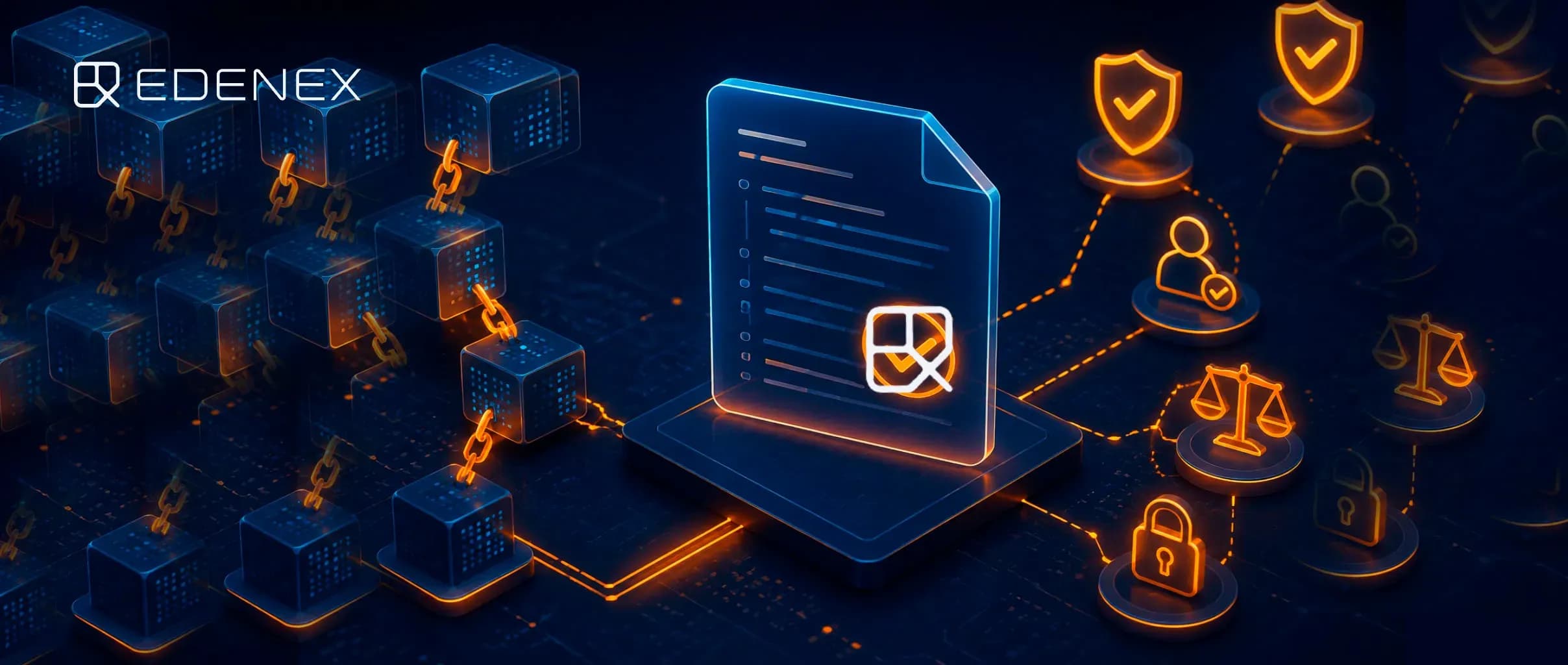
The proxy contract architecture separates data storage from executable logic. The "entry point" routes calls to the current module, allowing administrators to replace the software code without moving the owner registry. The asset state remains unchanged, while regulatory parameters are updated in real time. The compliance module encapsulates algorithms for eligibility verification and limits. An authorized issuer delegates rule updating authority via RBAC (Role Based Access Control). Every operation passes through a verifier that blocks the transaction if it does not comply with current legal requirements, without affecting the core asset logic.
Response to sanctions actions is automated through integration with external AML oracles. Streaming data from providers (Chainalysis, Elliptic) is fed into the smart contract, updating OFAC or EU restriction lists. If the sender's address matches a "blacklist," the system transitions the asset to a freeze status without human intervention.
This pattern ensures smart contract adaptation to legal changes and integration with banking infrastructure. Timely enforcement of regulatory requirements reduces the likelihood of penalties for AML/CFT violations. The legal stability of the registry is preserved, while access rules are promptly adjusted to the current regulatory landscape.
| Criterion | Traditional Bank Financial Monitoring Department (TradFi) | Programmable Compliance Architecture Based on Smart Contracts |
|---|---|---|
| Speed of sanction transaction blocking | Low / Delayed (T+1 – T+3). Depends on batch data processing in SWIFT/SEPA networks and the chain of correspondent banks. | Instantaneous (Real-time / T+0). Blocking occurs at the code execution stage (within milliseconds) via an on-chain verifier. |
| Cost of maintaining compliance procedures | High. Requires expenditures on maintaining a staff of auditors. | Lower / Optimized. Reduced through the automation of checks and the elimination of manual auditing. |
| Risk of human error (human factor) | High. The static KYC model does not account for the dynamics of sanctions lists. | Minimal. The risk is eliminated through deterministic validation via code. The governance process and rule updates (Policy Engines). |
| Auditability for the regulator | Difficult / Opaque. Auditing requires access to multiple internal systems and paper documentation. | High / Full transparency. Ensured by recording all status changes and rule changes on the blockchain. The auditor has access to an immutable history (state hashes). |
Institutional Standard: Edenex Security Infrastructure
The presented architecture of programmable compliance is not an abstract concept. It is implemented, for example, in the infrastructure of the Edenex platform, which acts as a global partner aggregator for trade finance. At its core is the Edenex Digital Financing & Trade IT module, managing the full lifecycle of an export transaction from application to automatic distribution of payouts via smart contracts.
A key element implementing Perpetual KYC principles is the Sumsub compliance gateway. Developed in accordance with ADGM (Abu Dhabi Global Market) standards, it provides automatic counterparty verification (KYC/AML/KYB) and sanctions screening at every stage of the transaction. Upon detecting deviations, the system automatically suspends the operation, consistent with the instant blocking principle (T+0) described above.
Additionally, to protect institutional investors' interests, Edenex uses an asset isolation mechanism via an SPC (Special Purpose Company). This creates an additional legal barrier, ensuring that even in the event of the exporter's bankruptcy, tokenized trade receivables remain under investor control and are not included in the bankruptcy estate. Thus, the platform addresses one of the key challenges of the RWA market, providing security comparable to traditional financial instruments.
Frequently Asked Questions (FAQ)
Does programmable compliance mean that the issuer can arbitrarily seize investor assets?
No. Confiscation and freeze procedures must be hard coded into the contract logic and triggered only by predefined triggers: a signal from a certified AML oracle, a sanctions match, or a court order. Arbitrary seizure without a stipulated basis should not be technically available.
How does programmable compliance protect against secondary sanctions risk when RWA tokens are resold on the secondary market?
It verifies not only the initial purchaser but also every subsequent holder based on on chain/KYC status, jurisdiction, and sanctions lists. If a risky address is identified, the contract blocks the transfer before execution, not after the transaction, reducing exposure for the issuer, the platform, and counterparties.
Does updating compliance rules require re issuance of old tokens?
Usually not. Under a modular architecture, only the verification logic or policy layer is updated, while the asset state and owner registry remain unchanged. Re issuance is only needed if the token structure or rights model changes so fundamentally that the old scheme can no longer correctly enforce new rules.
Can programmable compliance slow down settlements and reduce liquidity?
With a proper architecture — no: the check is performed before transaction execution and takes milliseconds, not days. Liquidity is preserved because rules are applied at the validation level, without manual pauses, batch processing, or asset migration.