generated gpt
Top 10 Popular Cryptocurrencies and Their Features: What Investors Need to Know
By 2026, crypto is no longer a gamble—it's a regulated asset class. We break down the top 10 cryptocurrencies by market cap, from Bitcoin's safe-haven status to the rise of RWA and AI infrastructure. Discover the new metrics driving value: real yield, institutional liquidity, and regulatory compliance. A must-read for the modern investor.

By 2026, the institutional transformation of the crypto market is complete. The integration of spot ETFs, the full implementation of the European MiCA regulation, and regulatory consolidation in U.S. jurisdictions have moved digital assets into the category of standard instruments for a balanced portfolio. Cryptocurrencies have transitioned from the category of high-risk derivatives into a class of regulated financial products with a predictable legal status.
Market capitalization has lost its status as a key indicator of a project's sustainability. In the current reality, investors are focused on the metric of real yield — the actual volume of fee income generated by the protocol. Asset valuation is based on the level of network decentralization, institutional liquidity, and the infrastructure's ability to service RWA, cross-border payment rails, and the computing power of AI sectors.
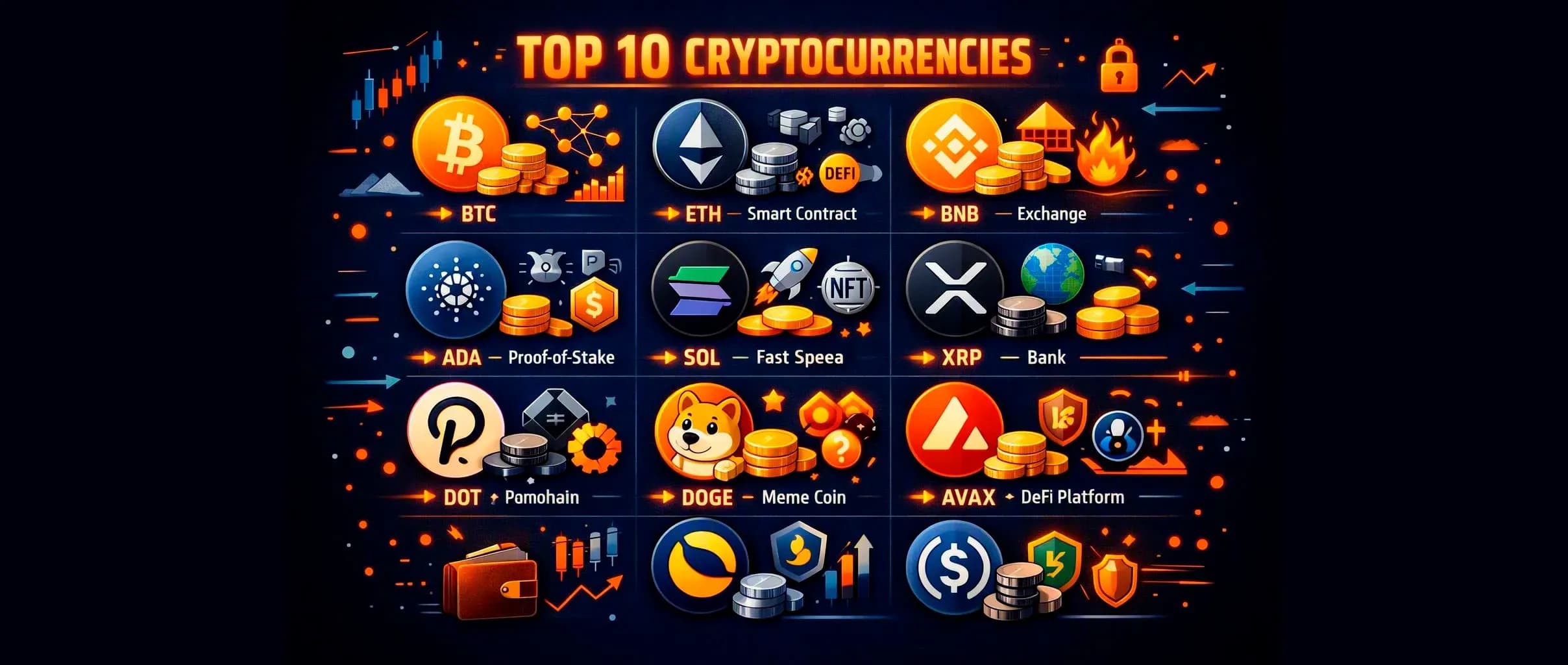
According to Coinmarketcap data, the crypto market volume at the end of July 2026 is $2.17 trillion. Below is an overview of the top 10 cryptocurrencies as of today.
Top 10 Cryptocurrencies by Coinmarketcap
Key Features of the Top 10
Assets in the top 10 have a number of unique features that distinguish them from the general mass:
Liquidity and Order Book Depth
Assets in the top 10 are characterized by a concentration of liquidity on centralized exchanges (Binance, Coinbase, Kraken) and a parallel presence on institutional OTC desks. A constant influx of capital from institutional players neutralizes local demand shocks, forming a dense order book. Decentralized platforms and market makers keep the spread within basis points, preventing critical volatility during large trades.
Regulatory Compliance
The status of assets is determined by the classification of the SEC and international regulators. Bitcoin, Ethereum, and licensed stablecoins (USDC, EURC) possess legal clarity, eliminating the risk of forced delisting. In contrast, unclassified altcoins carry the risk of being deemed unregistered securities. Solana and TRX maintain their infrastructural significance due to high throughput, ensuring the transaction flow of DeFi protocols.
Utility and Special Assets
Another feature of strong cryptocurrencies is the real generation of income: yield from staking, fees from smart contract execution, and the depth of integration with TradFi gateways. Preference is given to protocols with a positive cash flow balance and on-chain transparency. An exception in the top 10 is Dogecoin, which occupies a niche as an asset with a high concentration among retail investors, lacking a centralized issuer, which removes it from the standard formulas of the Howey Test.
Analysis of the Top 10 Cryptocurrencies: Architecture, Roles, and Investor Profile
Now let's look at each cryptocurrency in the top 10 in detail:
Bitcoin (BTC)
A digital analog of gold, a core asset for institutional finance, with a hard cap after the halving. BTC accounts for more than half of the total crypto market capitalization — $1.27 trillion. The current price of the asset is firmly above $63,000. The all-time high price of BTC is $126,000. Bitcoin maintains its status as the primary safe-haven asset in the crypto market.
For institutional players, this asset acts as a digital equivalent of gold. The limited supply ensures protection against inflationary processes in fiat systems. The high level of liquidity allows large structures to allocate capital flexibly. Integration into traditional financial mechanisms makes it the foundation for shaping market trends. Security, guaranteed by the Proof-of-Work mechanism, confirms its reputation as the most reliable asset.
Ethereum (ETH)
The foundational settlement layer for smart contracts, institutional DeFi, and the tokenization of real-world assets. The market cap of ETH currently exceeds $230 billion. Despite volatility, the current price is set at $1,874.21. The project serves as the foundation for the vast majority of decentralized financial applications. The ecosystem is actively scaling through the adoption of Layer-2 solutions.
Staking ETH supports network security and generates income for large holders. Liquid staking protocols increase market cap and stimulate activity in the DeFi sector. Tokenization of real-world assets makes the network in demand for the corporate sector. Planned upgrades reduce gas fees, making operations more accessible. Ethereum remains a technological benchmark for developers worldwide.
Solana (SOL)
A high-performance infrastructure for micropayments, DePIN networks, and B2C applications. The current market price of the asset is just over $73. The total network capitalization has reached $42.61 billion. High throughput ensures the processing of thousands of transactions per second. Minimal fees attract a mass audience to the blockchain space.
The network is actively strengthening itself as a hub for DePIN and blockchain-based gaming projects. Parallel transaction processing makes SOL an effective instrument for micropayments. Ease of integration attracts developers of mobile B2C applications. High community activity contributes to the rapid growth of market valuation. Technological innovations distinguish the project against traditional platforms.
BNB (BNB)
An ecosystem token of a major infrastructure hub and provider of CeFi liquidity. The asset's market cap stands at an impressive $75.42 billion. The current price of one token is fixed at $566. BNB provides discounts on fees and access to exchange instruments. Periodic token burn mechanisms support a deflationary model.
BNB Chain opens up broad opportunities for launching new DeFi projects. The infrastructural power of the hub attracts millions of users worldwide. The exchange's high liquidity makes the token a key instrument for trading. Versatility of use within the ecosystem strengthens its market positions. The scalability of the network allows it to process colossal transaction volumes daily.
XRP (XRP)
Interbank cross-border settlements and liquidity provision in institutional channels. The current market price of XRP is around $1.04. The project's market cap has reached $65.63 billion. The primary goal of the network is to accelerate international transfers and currency conversion. The technology allows financial institutions to reduce liquidity costs.
Banks use the network for instant transfers between countries. The protocol's scalability is suitable for working with global fiat markets. The project actively cooperates with government regulators in different states. High transaction speed makes XRP competitive compared to the SWIFT system. The ecosystem continues to develop as a reliable tool for cross-border operations.
USDT (Tether)
A key liquidity instrument in emerging markets and cross-border B2B trade. The asset's market cap has reached an impressive $183.8 billion. Tether is regularly subject to regulatory reviews, which is important for the B2B sector. Exchange rate stability allows traders to hedge risks effectively. The asset acts as the primary link between fiat and digital money.
High token turnover confirms its status as the main unit of account. In emerging markets, it is used as a means of savings and exchange. Integration across all exchanges makes USDT the market's universal currency. Despite reviews, business trust in USDT remains high. Uninterrupted system operation ensures the liquidity of global crypto trades.
USDC (Circle)
The standard for institutional settlement fiat for regulated financial structures. The product was created by the American company Circle and launched in 2018. USDC's market cap at the end of July 2026 was $72.43 billion. The reserve model ensures transparency, as funds are held with BlackRock. In June 2025, the company successfully held an IPO on the NYSE under the ticker CRCL.
The reserve structure includes Treasury bills and cash. Compliance with SEC regulations makes the token preferable for institutional investors. The company's IPO further strengthened its reputation for reliability. Use in regulated financial institutions increases the trust of large funds. USDC serves as a benchmark for a safe stablecoin for the global economy.
TRON (TRX)
A foundational settlement layer for stablecoin traffic, primarily USDT, with clear dominance. The project leads the segment of low-cost on-chain transfers. The current token price is around $0.32 with high network activity. Market cap has reached a significant $30.74 billion. Low fees cement the network as infrastructure for B2B settlements.
The delegated consensus model reduces latency and increases throughput. A significant share of global Tether transactions passes through the network. The utility token is used for fee payment and staking. A pronounced dependence on stablecoin turnover ensures stable demand. Efficient network management makes it attractive for arbitrage strategies.
Hyperliquid (HYPE)
The native token of an on-chain perpetual contract exchange with its own L1 infrastructure. The project is focused on complex derivatives and high-frequency trading. HYPE accumulates fee flow through profit redistribution mechanisms. The current asset price is $54.25 with a market cap of $13.27 billion. The architecture with off-chain order matching supports a dense and liquid order book.
The token is actively used in staking, governance, and reducing trading fees. The project's valuation is directly tied to trading volumes and open interest. The main risk is the concentration of liquidity and dependence on the matching engine's algorithms. High volatility creates opportunities for aggressive trading. The innovative approach to L1 makes the exchange a competitor to traditional CeFi platforms.
Dogecoin (DOGE)
Closing the top 10 is the most popular memecoin, known for its community. Unlike other assets, Doge does not rely on complex compliance. The main value of the project rests on culture and the support of prominent figures. The current token price is slightly above $0.06 per unit. The memecoin's market cap at the end of July is about $11.88 billion.
Public recognition makes the asset a unique phenomenon in the cryptocurrency environment. Public statements often cause sharp changes in quotes. The absence of infrastructural complexities makes it understandable for newcomers. Despite its speculative nature, the coin maintains its leading positions. The cultural weight of Dogecoin continues to grow thanks to support from enthusiasts worldwide.
| Asset | Category | Key Source of Value | Institutional Adoption | Volatility Level | Main Risk |
|---|---|---|---|---|---|
| Bitcoin (BTC) | Digital Gold / Macro Asset | Supply cap (halving), safe-haven status, PoW security | High (TradFi, ETFs, corporate treasuries) | Medium-High | Regulatory pressure, macro trend shift |
| Ethereum (ETH) | Foundational L1 / DeFi Platform | Smart contracts, RWA tokenization, staking, gas fees | High (institutional DeFi, corporations) | High | Technical vulnerabilities, L2 competition, gas prices |
| Solana (SOL) | High-Performance L1 | Speed, low fees, DePIN and B2C application ecosystem | Medium (growing fund interest) | Very High | Network outages, validator centralization, competition |
| BNB (BNB) | Exchange / Ecosystem Token | Exchange discounts, token burns, BNB Chain infrastructure | High (CeFi hub, largest exchange) | Medium | Regulatory risks against Binance, dependence on exchange |
| XRP (XRP) | Payment / Interbank | Speed of cross-border transfers, alternative to SWIFT | Medium-High (bank collaborations) | High | Past SEC litigation, low decentralization |
| USDT (Tether) | Stablecoin (Fiat-Backed) | Liquidity, fiat on/off ramp, exchange dominance | Very High (B2B, emerging markets) | Low (pegged to $1) | Reserve opacity, regulatory scrutiny, depeg |
| USDC (Circle) | Stablecoin (Regulated) | Transparent reserves (BlackRock), SEC compliance | Very High (banks, regulated funds) | Low (pegged to $1) | Reserve credit risks, regulatory tightening |
| TRON (TRX) | Settlement L1 for Stablecoins | Low-cost transfers, USDT traffic dominance, staking | Medium (B2B payments, arbitrage) | Medium | Dependence on USDT turnover, centralization (DPoS) |
| Hyperliquid (HYPE) | On-Chain Derivative L1 | Perpetuals trading, HFT, fee flow | Low (niche product) | Very High | Liquidity concentration, algorithmic failures |
| Dogecoin (DOGE) | Memecoin / Cultural Asset | Community, celebrity support, simplicity | Low (speculators, retail) | Extremely High | Dependence on hype and tweets, lack of fundamentals |
Risk Management Strategy for Building a Digital Portfolio
A sound diversification model in 2026 is based on a three-tier capital allocation structure. The base level (50–60%) is formed by BTC and ETH as instruments with maximum liquidity, serving as collateral in DeFi protocols. The medium-risk segment (20–30%) is allocated to Layer-1 networks with high throughput and RWA assets, providing a link to derivatives of real sectors.
The remaining 10–20% of the portfolio is held in stablecoins for implementing a dollar-cost averaging strategy during market volatility and hedging drawdowns.
Reducing counterparty risk requires a complete abandonment of holding liquidity on centralized exchanges. The optimal standard is using Qualified Custodians that meet compliance requirements and have deposit insurance coverage.
Interaction with assets is shifted to MPC (Multi-Party Computation) solutions, which eliminate a single point of failure by distributing the private key across independent mathematical shards. This architecture minimizes the likelihood of access compromise and ensures compliance with institutional-grade internal security protocols.
Platform Edenex: A Secure Gateway to the World of Digital Assets
Frequently Asked Questions (FAQ)
What is the difference between investing in physical Bitcoin and buying shares of a spot BTC ETF?
Direct ownership of BTC provides sovereign control over private keys and eliminates counterparty risks. A spot ETF is a derivative financial instrument that provides exposure to the asset's price without the need for independent management of cryptographic storage.
Why are stablecoins (USDT/USDC) included in the top 10 cryptocurrencies if they do not increase in value?
They act as a liquid transactional layer, providing instant access to capital. High velocity of circulation allows for effective cost averaging during drawdowns and instantaneous reallocation of assets between DeFi protocols.
How did the FASB ASU 2023-08 tax standard simplify the holding of cryptocurrencies on the balance sheets of traditional companies in 2026?
The standard introduced fair value measurement of assets, which eliminated the need to record impairment losses. This simplified corporate ownership, increased reporting transparency, and reduced the tax burden on company balance sheets.
Which assets should be looked at in the future?
It is worth looking at projects with proven utility: tokenized real-world assets (RWA), high-speed Layer-1 payment rails, and decentralized networks providing computing power for AI infrastructure.