generated gpt
Financing Deficit — The Exporter's Problem in 2026. How Tokenized Assets (RWA) Are Changing the Rules of the Game
The global trade finance deficit has reached $2.5 trillion a year. Banks are withdrawing from the MSME segment, and exporters are losing orders. Tokenized export contracts (RWA) are emerging as an alternative channel: 15-45 days instead of months, legal isolation of the asset through an SPV, insurance, and real-time monitoring via oracles. Market forecasts range from $2 trillion to $16 trillion by 2030.

The global trade finance market has hit a systemic crisis. According to the Asian Development Bank, the liquidity gap for export-import operations has reached $2.5 trillion per year. That is roughly 10% of global trade volume.
The reason is that banks in virtually every country today are tightening requirements for borrowers, especially for small and medium-sized businesses. As collateral, they demand real estate or equipment, which many companies simply do not have. Banks' document verification and limit approvals take weeks and months.
As a result, exporters that have contracts and buyers cannot obtain working capital and lose orders: contracts go to competitors.
In such a situation, new financing models are emerging in the market. We spoke with Sergey Abisher, head of new projects at Edenex, about how the approach to trade finance is changing and why businesses are looking for alternatives to banks.
— Sergey, what is the problem with financing exporters?
The problem has existed for a long time, but in recent years it has reached a critical point. A typical scenario: a company wins a tender, purchases raw materials, produces goods, ships them, and receives payment 90-120 days later. All this time its working capital is frozen, and banks are unwilling to issue it a loan. As a result, the company cannot take on the next order.
— Why has this become critical right now?
Three factors have converged at the same time.
The first is tighter bank regulation after the 2008 financial crisis. Regulators introduced strict capital requirements for banks. This refers to Basel III and subsequent packages. Now, for each loan, a bank must reserve more of its own funds.
In trade finance, cycles are long and prices are volatile. This means it has simply become unprofitable for banks to lend to mid-sized companies. The costs of verification and reserving for deals of $1 million and $50 million are roughly the same, but the profit from a small deal does not cover the costs. Banks choose large players, while MSMEs are left out in the cold.
The second is geopolitical fragmentation. Sanctions, trade wars, and the restructuring of logistics routes have made international trade more complex and riskier. Banks are strengthening compliance checks of counterparties, especially when working with jurisdictions outside the EU or the US. In 2026, verifying a single counterparty can take weeks: it is necessary to check sanctions lists, ultimate beneficial owners, the supply chain, and the origin of goods. Banks simply cannot keep up with the speed of the market.
The third is a structural shift in trade itself. Payment cycles are lengthening. If previously 30-60 days was considered the norm, now large buyers dictate terms: 90-120 days and even more. Logistics have become more expensive, routes longer, supply chains more tangled. All of this increases the need for working capital precisely at the moment when banks are reducing it.
And here is the result: the global trade finance deficit has reached $2.5 trillion. Banks have withdrawn from the segment. A huge demand for financing has emerged that cannot be covered by classical methods.
— If the problem is systemic, why is it not being solved with traditional financial instruments?
Banks are conservative institutions. They work with large corporations that have a credit history and a collateral base. If none of this exists, banks are usually not interested in cooperating.
In addition, for small and medium-sized businesses, speed is often decisive. If counterparty verification, document analysis, and limit approvals take weeks and months, the model becomes meaningless. During that time, the contract may go to a competitor.
— What alternatives to traditional bank financing exist for exporters, and how exactly do the new models work?
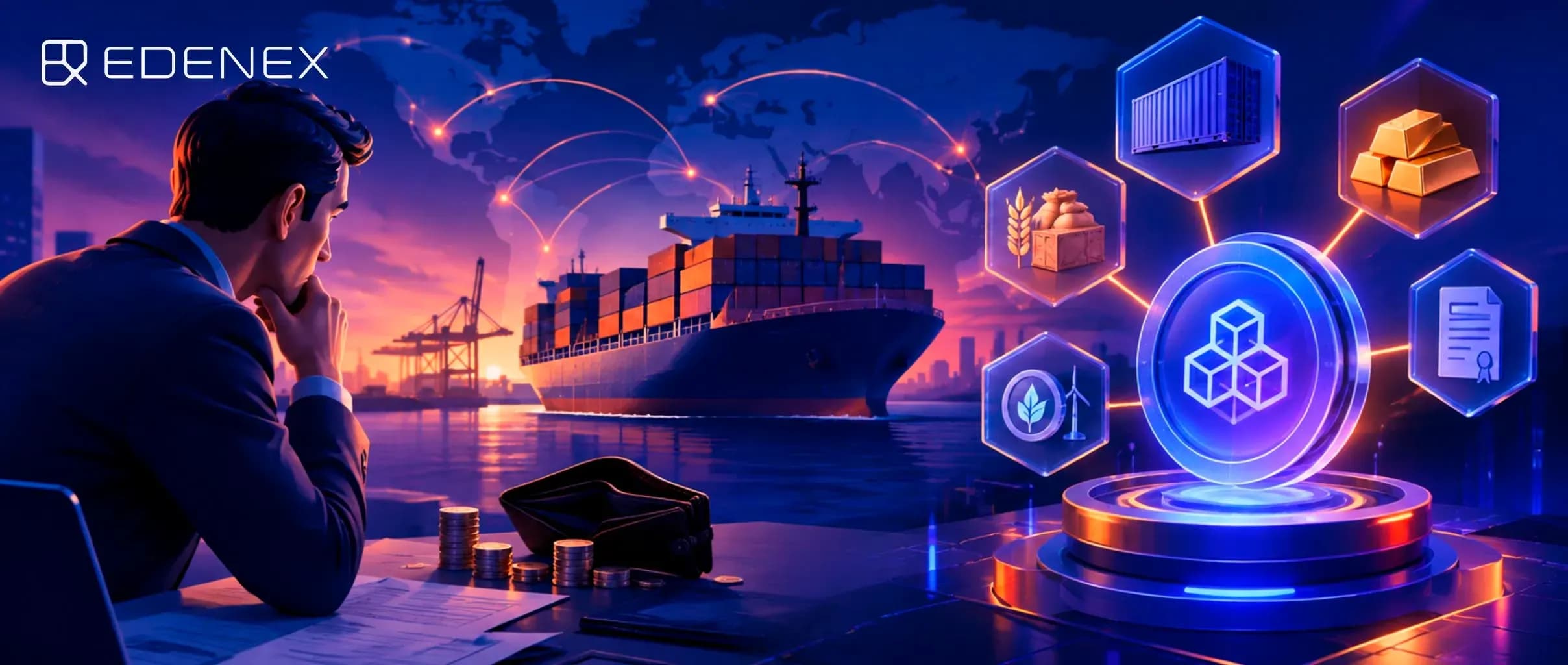
One of the most notable alternatives is the tokenization of export contracts. Such technology makes it possible to turn a claim right under an invoice into a digital asset (a token). It records all parameters of the transaction: amount, terms, buyer, payment conditions.
A business can offer the token directly to institutional investors, bypassing intermediary banks. Investors see not an abstract "debt" but a transparent chain: contract, shipment, insurance, delivery confirmation. They readily finance it.
After shipment confirmation, the funds arrive in the exporter's account. The entire cycle takes 15-45 days depending on the category of goods. By comparison: in a classical bank, an analogous process can last for months.
However, the new model is not a replacement for banks. It is an alternative channel for cases where banks cannot work fast enough.
— How are investors protected in such models against the risk of non-payment or bankruptcy of the exporter?
Investor protection is built from several components. The first and key one is the legal isolation of the asset. The claim right under the contract is transferred to a separate legal entity — an SPV (Special Purpose Vehicle).
The asset is legally separated from the exporter's balance sheet. If it goes bankrupt, its creditors cannot make claims against this asset. The investor receives a priority right to the cash flow under the contract. This mechanism works independently of the exporter's financial condition.
The second level is insurance. Cargoes and the contracts themselves are insured by professional insurance companies. If the buyer does not pay for the shipment or the cargo is damaged, the insurance covers the investor's losses. This is standard practice in international trade. In combination with tokenization, it becomes more transparent and automated.
The third level is real-time monitoring. Data from GPS trackers on cargoes, information on customs clearance, and confirmations from logistics operators are used. They are provided by so-called oracles — systems that transmit data to smart contracts.
If something does not go according to plan (for example, the cargo is delayed or deviates from the route), the smart contract automatically blocks payment until the circumstances are clarified. The investor sees the status of the transaction in real time and can make decisions based on current data.
Taken together, these mechanisms make tokenized export assets reliable even in comparison with classical banking instruments. And in terms of transparency, they even surpass them.
— In which markets and with which goods are such financing models most in demand?
The need for alternative financing is most acute in industries with long production and payment cycles, complex logistics, and non-standard contracts. These are metallurgy and mining, woodworking, agribusiness, textiles, mechanical engineering, electronics, and the production of components.
In these sectors, traditional banks most often refuse financing. They cite various reasons. For example, the transaction is long and does not fit standard credit products. Or because of the complexity of verifying supply chains. Sometimes the counterparty is in a jurisdiction that the bank considers risky.
As for geography, the need for alternative instruments is highest in developing markets and for supplies to complex jurisdictions. It is there that the trade finance deficit is most acute. Imagine an exporter from Southeast Asia that supplies grain to the Middle East. It will encounter the fact that its local bank does not want to work with this route, and the buyer's bank does not want to work with its counterparty.
Alternative financing models are not tied to a specific country — they work wherever there is a cross-border commodity flow.
— What is the market volume of such instruments and what are the forecasts?
The market for tokenized real assets on public blockchains already exceeds $29 billion — 3.6 times more than in 2024. And this is only public blockchains, without taking into account private institutional platforms. The real volume of operations with digital assets backed by real goods and cash flows is significantly higher.
Forecasts from the largest consultants vary, but all point in one direction. Boston Consulting Group and Standard Chartered predict that by 2030 the market for tokenized assets could reach $16 trillion — almost 10% of global GDP. McKinsey gives a more conservative estimate — $2-4 trillion, but even in this scenario we are talking about a gigantic market.
So far the technology is at an early stage, but the vector is obvious: institutional capital is shifting toward instruments backed by real assets. Investors are tired of the volatility of unbacked crypto assets and are looking for predictable returns with legal protection.
The overall growth potential is enormous. The global trade finance market is estimated at $4.5 trillion per year, and a large part of it is still serviced by paper processes and manual underwriting. Moving at least 5-10% of this volume into digital form represents hundreds of billions of dollars of new market space.
— How is compliance with regulatory requirements and standards ensured in such models?
Compliance with regulatory requirements is a mandatory condition for working with institutional capital. Any system that claims to interact with Private Credit funds, insurance companies, or pension money must be integrated into the existing legal environment, rather than trying to bypass it.
Such solutions are based on several key principles. The first is verification of transaction participants. These are standard AML (anti-money laundering) and KYC (know your customer) procedures, as well as sanctions screening of counterparties. All participants undergo multi-level verification before gaining access to the platform. This applies to exporters, investors, and logistics operators.
The second is data processing in accordance with international standards. Thanks to this, the personal data of participants is protected.
The third is the legal structure of transactions. In digital systems working with tokenized assets, certification under ADGM (Abu Dhabi Global Market) standards is often used — one of the strictest regulatory regimes in the world. This ensures uniform rules of the game for all participants, regardless of their geographic location.
The fourth is transparency for regulators. Each investor receives a full package of documents on the transaction, which can be provided to its regulator or auditor. This is not a "gray zone" but a legally clean construct. Each stage of the transaction is documented, and the rights and obligations of the parties are clearly defined.
Thus, alternative models do not attempt to work around regulators. On the contrary, they use today's technologies to effectively comply with requirements and conduct transactions transparently.